Every rental counter in Italy runs some version of the same script: your reservation already includes basic coverage, but would you like to add full protection for total peace of mind? It’s a fair question with a genuinely confusing answer, because “basic coverage” varies by company, “full protection” isn’t standardized, and most of what’s being offered depends entirely on what you already have through your credit card or travel insurance.
Here’s what the coverage terms actually mean, what’s typically included by default, and where people end up paying twice for the same protection.
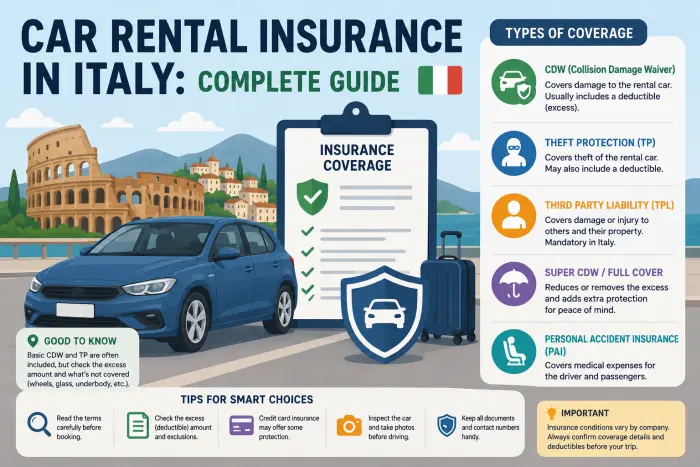
Italian rentals almost always include CDW (Collision Damage Waiver) and theft protection by default, but both come with an excess/deductible — often €800–€1,500 — that you’re liable for out of pocket if something happens. Buying the rental desk’s “full coverage” reduces that excess to zero, but often duplicates coverage many credit cards or third-party insurers already provide at a fraction of the price.
Wondering whether your card already covers this? Our guide to which credit cards cover rental car insurance in Italy breaks down what major card networks typically include before you pay for anything extra.
What’s Included in Standard Rental Insurance
By Italian law, every rental agreement must include a baseline of coverage: third-party liability (covering damage or injury to others), collision damage coverage, and theft protection. This isn’t optional or something companies can skip — it’s the legal minimum. What varies enormously is the excess amount attached to that coverage, and whether the company automatically includes anything beyond the legal baseline.
Budget and mid-tier companies typically stick to the legal minimum with a higher excess; premium companies sometimes include a lower excess as standard, reflected in a higher daily rate. Reading the actual rental voucher (not just the booking summary) is the only reliable way to know which one you’ve got.
CDW, LDW, TP: What the Acronyms Actually Mean
| Term | What It Covers | Notes |
|---|---|---|
| CDW (Collision Damage Waiver) | Damage to the rental vehicle from a collision | Standard, but leaves an excess amount you’re liable for |
| LDW (Loss Damage Waiver) | Broader version of CDW, sometimes includes loss/write-off scenarios | Terminology varies by company, often used interchangeably with CDW |
| TP (Theft Protection) | Coverage if the vehicle is stolen | Usually bundled with CDW as standard |
| Super CDW / Zero Excess / Full Protection | Reduces or eliminates the excess amount on CDW/TP | Paid upgrade, pricing and inclusion vary by company |
| PAI (Personal Accident Insurance) | Covers medical costs for driver/passengers in an accident | Often overlaps with travel insurance or health coverage |
The naming isn’t standardized across companies, so “Full Protection” from one provider might mean something slightly different from another’s “Premium Cover” — it’s worth reading exactly what excess amount (if any) remains after the upgrade, not just trusting the marketing name.
Understanding the Excess (Deductible)
The excess is the amount you’re financially responsible for if the car is damaged or stolen, even with standard CDW/TP included. Say the excess is €1,200 and the car sustains €400 in bumper damage — you pay the full €400, not a percentage. If the damage is €3,000, you’re liable for the €1,200 excess, and the CDW covers the rest.
This amount is usually pre-authorized on your credit card at pickup (a hold, not an actual charge), released after the car is returned undamaged. It’s a common source of unpleasant surprises for renters who expected “insurance included” to mean zero financial exposure — worth understanding clearly before you sign, alongside other line items covered in our guide to avoiding hidden rental costs in Italy. It’s a separate hold from the security deposit itself, and the two are easy to confuse at pickup.
The Desk Upsell: Is It Worth It?
The in-person upgrade offered at pickup typically reduces the excess to zero (or close to it) for a daily fee, often €15-€35 depending on the vehicle class. It’s convenient — no claims process, no reimbursement paperwork, no waiting — but it’s also usually the most expensive way to get that protection.
Whether it’s worth paying for at the counter comes down to two questions: does your credit card already cover the excess gap, and would a pre-purchased third-party policy be cheaper for the same protection? For most travelers who’ve done either of those in advance, the desk upsell is redundant. For travelers who haven’t looked into either beforehand, it’s a reasonable (if pricier) safety net rather than a scam.
If you want the actual numbers behind that comparison — typical excess amounts, what Super CDW costs per day versus what an independent excess policy costs, and exactly what even the priciest tier still doesn’t cover — our dedicated breakdown of CDW vs Super CDW in Italy goes deeper into the decision than this overview has room for.
And if you do end up paying an excess and you’re covered by a third-party policy or eligible card benefit, getting that money back isn’t automatic — it’s a separate paperwork process with its own document checklist and realistic timeline, which we walk through step by step in filing an insurance claim after a rental car accident in Italy.
Does Your Credit Card Already Cover This?
Many premium travel credit cards include rental car excess/collision coverage as a cardholder benefit, provided the full rental is paid on that card. Coverage terms vary significantly by card issuer, card tier, and sometimes by country of card issuance — some offer primary coverage (kicks in first, no need to claim elsewhere), others secondary (covers what’s left after other insurance pays out).
💸 Italy Car Rental Sale – Up to 40% Off Today
Find the cheapest car rental deals in Rome and across Italy. Compare prices instantly and lock in your discount before it's gone.
Specific cards vary enough that it’s worth checking the actual terms rather than assuming — our breakdown of Amex Platinum car rental insurance for Rome pickups is a useful example of how detailed and card-specific this coverage can get, and it’s a good idea to check your own card’s benefits guide the same way before assuming you’re covered. US-issued cards in particular vary widely on this point — our rental insurance guide for American travelers in Italy goes deeper into that specific situation.
Third-Party Excess Insurance
Independent of both the rental company and your credit card, standalone excess insurance policies — purchased online before the trip from third-party insurers — reimburse the excess amount if you’re charged for damage. These policies are typically priced per day at a fraction of what the rental desk charges for the same protection, though they work on a reimbursement basis: you pay the excess charge upfront if damage occurs, then file a claim to get it back, rather than avoiding the charge entirely at pickup.
This trade-off (cheaper, but reimbursement-based rather than instant) is worth weighing against the desk upgrade’s higher price but zero-hassle structure, especially for travelers who’d rather not deal with a claims process while also managing the rest of a trip.
What’s Never Covered, Regardless of Policy
A few scenarios fall outside standard insurance no matter which coverage level you’ve purchased:
- Damage from driving under the influence — insurance is void in drink-driving-related incidents, a detail covered more fully in our guide to BAC limits in Italy
- Damage to tires, windshield, and undercarriage — often excluded or covered separately, worth confirming specifically
- Interior damage or missing accessories — cleaning fees and lost items (chargers, keys) are usually billed regardless of coverage level
- Fines and toll charges — these are the renter’s responsibility entirely, not an insurance matter
That third-party liability piece — RCA, or Responsabilità Civile Auto — is worth understanding on its own, since it’s the coverage most often confused with CDW even though it protects something completely different: other people and their property, not your rental car. Italy’s mandatory RCA minimums are also considerably higher than what many travelers expect coming from home — our guide to RCA insurance in Italy breaks down exactly what it covers and how its limits compare to typical US state minimums.
Insurance questions often come up alongside payment-method questions at pickup…
One more gap worth knowing about before it becomes relevant: theft protection and CDW typically cover the vehicle itself, not what’s inside it. If your car is broken into rather than damaged in a collision, the claim works differently — our guide to what to do if your rental car is broken into or stolen in Rome covers both the police-report process and where insurance does and doesn’t step in for that specific scenario.
Insurance questions often come up alongside payment-method questions at pickup — if you’re paying by debit rather than credit, it’s worth reading our guide on renting a car in Rome without a credit card, since the excess hold typically needs a credit card either way. Getting the insurance and payment details straight before pickup avoids most of the desk-side confusion covered in our rundown of common rental mistakes in Italy.
FAQ
Is car rental insurance required by law in Italy? Yes, a legal minimum of third-party liability, collision damage waiver, and theft protection is required in every Italian rental agreement, though the excess amount attached varies by company.
What is an “excess” in rental car insurance? It’s the amount you’re financially responsible for if the car is damaged or stolen, even with standard coverage included — typically €800-€1,500, often pre-authorized on your card at pickup.
Should I buy the rental company’s full coverage upgrade? It depends on whether you already have coverage through a credit card or a pre-purchased third-party policy. If you don’t, the desk upgrade is a reasonable (if pricier) way to eliminate the excess risk.
Does my credit card cover rental car insurance in Italy? Many premium travel cards do, but coverage varies by issuer and card tier, and whether it’s primary or secondary coverage matters. Check your specific card’s benefits guide rather than assuming.
Is third-party excess insurance cheaper than the rental company’s coverage? Usually yes, though it works on a reimbursement basis — you pay the excess if damage occurs, then claim it back — rather than avoiding the charge upfront like the desk upgrade does.
Does rental insurance cover damage from an accident while driving under the influence? No. Insurance coverage is void in drink-driving-related incidents regardless of which coverage level was purchased.
Are tires and windshields covered under standard rental insurance in Italy? Often not, or only partially — these are frequently excluded or require separate coverage, so it’s worth confirming specifically at pickup.
What’s the difference between CDW and LDW? The terms are often used interchangeably, though LDW sometimes covers a broader range of loss scenarios. Naming varies by company, so it’s worth checking what’s actually included rather than relying on the acronym alone.