
There’s a small but telling detail in a lot of the accounts people post after this happens to them in Italy: the police officer who takes their report doesn’t seem surprised at all. One traveler was told, flatly, “normalissimo” — completely normal. Another had their window smashed a single block from the Vatican, in a lot they’d specifically paid extra to use because it was labeled secure. It’s not that Rome is uniquely dangerous, but a smashed window and a missing suitcase is common enough here that locals barely blink.
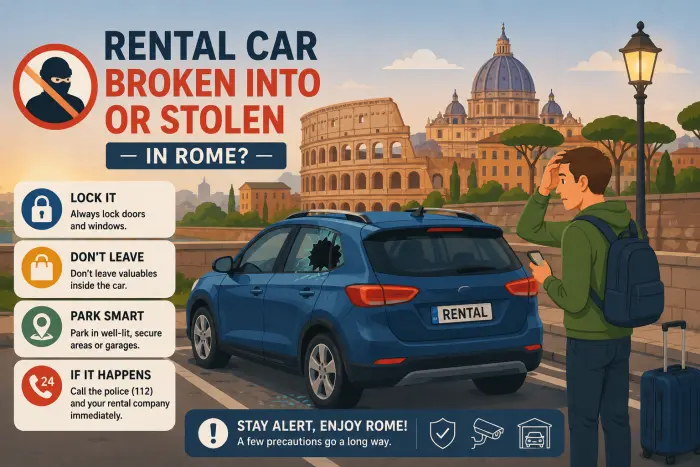
If it’s already happened to you, the panic is doing you no favors right now, so here’s the practical version: what to actually do in the next hour, what your rental insurance will and won’t touch, and what tends to make the difference between getting reimbursed and eating the loss yourself.
Break-in or theft — which one is this?
A smashed window with your bag missing is a break-in; the entire car disappearing from where you parked it is theft, and Italian police, your rental company, and your insurer treat them as genuinely different events. A break-in usually means someone shattered a window or forced a lock to grab whatever was visible — luggage, electronics, sometimes the car’s own infotainment unit. Theft means the vehicle itself is gone. Report the right one accurately; conflating the two on your paperwork can slow down both the police process and any insurance claim.
If you’re dealing with a collision instead — another car, a wall, a bollard — that’s a completely different process, and our guide to rental car accidents in Rome covers the CAI form and 112 threshold for that scenario specifically.
There’s also a third category worth knowing about: attempted theft, where someone tampers with the door lock or ignition but doesn’t get away with the car. It still gets its own line item on an Italian police report, distinct from a completed theft, and it’s worth reporting even though nothing was technically taken — insurers sometimes ask about prior attempts if you’re filing a claim later in the same trip.
What to do in the first 30 minutes
Call the rental company before you do almost anything else, because most agreements require notification within a set window and delaying it can complicate your claim regardless of what actually happened. After that:
- File a police report (denuncia) at the nearest Carabinieri or Polizia station — not optional, and not something you can substitute with a phone call. You’ll need this document for both the rental company and any insurance claim, including travel insurance back home.
- Photograph everything before you touch the car: the broken window, forced lock, empty trunk, the parking ticket or receipt showing where and when you left it.
- Get the report number and a copy, even if the officer implies nothing will come of it. Insurers and rental companies want the paper, not a verbal assurance that you filed one.
- Contact your embassy if a passport was among the stolen items — this needs to start moving in parallel, not after everything else is sorted.
- Cancel and freeze cards immediately if a wallet or cards were taken, the same as you would anywhere else in the world.
What rental insurance actually covers here
Standard CDW protects the vehicle itself from theft in most Italian rental agreements, but it almost never covers what was inside it. Your suitcase, camera, laptop, and passport are your property, not the rental company’s, so the car’s insurance has no reason to touch them — that’s a job for travel insurance or, in some cases, home contents coverage that extends abroad. This mirrors something we’ve flagged before with rental coverage: just like a lost or stolen rental car key is frequently carved out as a separate fixed liability regardless of your coverage tier, glass and lock damage from a break-in sometimes carries its own exclusion or a reduced deductible treatment — read your specific rental voucher rather than assuming standard CDW has you covered for everything.
Full theft of the vehicle is a different story: this is exactly what theft protection (sometimes bundled into a “Super CDW” or sold separately) exists for, and without it you could be liable for the car’s full value. It’s worth confirming which tier you actually bought before you’re standing at a police station finding out the hard way.
The uncomfortable statistics
Break-ins and theft-from-vehicle vary sharply by region in Italy, generally trending higher the further south you travel, but they’re widespread enough in Rome, Naples, and other major cities that experienced repeat travelers plan around it rather than hoping to avoid it entirely. One recurring detail worth knowing: the Fiat Panda is reportedly among the most frequently stolen car models in Italy — which happens to be one of the more common rental fleet vehicles you might actually be handed at the counter.
💸 Italy Car Rental Sale – Up to 40% Off Today
Find the cheapest car rental deals in Rome and across Italy. Compare prices instantly and lock in your discount before it's gone.
None of this means your trip is doomed. Most rentals in Rome go by without incident. But “it probably won’t happen” and “it happens often enough that locals have a shrug for it” are both true at the same time, and planning around the second one costs you nothing.
Prevention that actually works
The advice that comes up again and again from people who’ve been through this isn’t complicated, just consistently ignored under vacation pressure:
| Habit | Why it matters |
|---|---|
| Never leave anything visible in the car | An empty back seat gives a passerby nothing to act on |
| Pack your trunk before arriving, not after parking | Loading bags in a lot is a visible signal that valuables are inside |
| Use attended or covered parking over open street spots | Doesn’t guarantee safety, but removes casual opportunism |
| Take passports, meds, and cards with you, always | These are the items hardest to replace on the road |
| Crack a window slightly only for pets or melting chocolate, never for “airflow” | A cracked window is sometimes read as an easier target, not a smaller one |
If you’re weighing where to leave the car for a few hours while sightseeing, our Rome parking guide covers which options are genuinely staffed versus just labeled “secure” on a sign.
Does this count as a scam?
Not usually — and it’s worth being clear-eyed about the distinction. A break-in is opportunistic property crime, not a targeted trick aimed at renters specifically, which puts it in a different category from the deposit manipulation and pre-existing-damage tactics we cover in our guide to common rental scams in Rome. That said, if a rental company tries to bill you for damage from a break-in without a police report on file, or pressures you to pay cash on the spot before you’ve even filed one, that crosses into scam territory and deserves the same skepticism as anything else in that guide.
What happens to the rental agreement afterward 📋
Once the report is filed, the rental company will typically want a copy before releasing you from further liability on the vehicle, and if the car itself was stolen, you’ll likely need to work out return logistics or a replacement vehicle through them directly — there’s no standard playbook here since it depends heavily on which company and which coverage tier you’re on. Keep every document: the original rental agreement, the police report, photos, and any correspondence, because if there’s a dispute later about what was or wasn’t covered, paperwork is what settles it, not memory.
Frequently asked questions
Is it common for rental cars to be broken into in Rome? It’s common enough that it’s a recurring topic on nearly every Italy travel forum, though the majority of rentals still go without incident. Frequency varies by neighborhood, season, and how visible your belongings are.
Does rental car insurance cover stolen luggage? Almost never. CDW and theft protection cover the vehicle itself, not personal belongings inside it — that’s the domain of travel insurance or home contents coverage that extends internationally.
Do I have to file a police report if my rental car was broken into? Yes, in practice. Both the rental company and any insurance claim will require a formal police report (denuncia), not just a phone call describing what happened.
What’s the difference between reporting a break-in and reporting theft of the whole car? A break-in report describes damage to the vehicle and theft of its contents; a theft report describes the vehicle itself being taken. They trigger different processes with police and the rental company, so it matters which one you file.
Will I be charged for a broken window even if it wasn’t my fault? It depends on your coverage tier. Some glass and lock damage from a break-in falls under standard CDW, some is excluded or subject to a separate deductible — check your specific rental terms rather than assuming.
Are certain parking areas in Rome actually safer than others? Attended, staffed lots generally deter casual break-ins better than open street parking, though no option is guaranteed. Visibility of belongings matters more than the label on the parking sign.