
A collision is disorienting anywhere, and doing it in a foreign country with an unfamiliar process makes it worse — but Italy’s system, once you know it, is actually fairly structured. 🚔 The single most important early decision is whether this is a police-report situation or a CAI-form situation, since that determines almost everything that happens in the first hour, and getting it wrong in either direction creates real problems later.
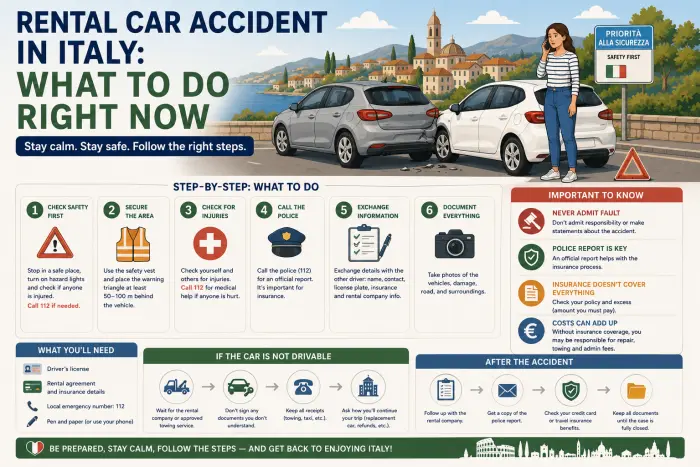
🚔 First Things First: Call 112 immediately if anyone is injured, if there’s a genuine disagreement about who caused the accident, if you suspect the other driver has been drinking, or if the damage looks significant. For a minor, no-injury fender-bender where both drivers agree on what happened, Italy (like most of Europe) uses a standard European Accident Statement — locally called the CAI (Constatazione Amichevole di Incidente) — filled out jointly at the scene instead of waiting for police. Photograph everything regardless of which path you’re on, call your rental company right away either way, and never admit fault verbally — stick to describing facts on the form and let the insurers work out liability.
When You Must Call the Police (112) 🚨
A handful of situations remove any judgment call about whether to involve law enforcement, and it’s worth knowing them before you’re standing on the side of a road trying to decide. Anyone injured, regardless of how minor it looks, means calling 112. A genuine dispute with the other driver about who’s at fault — not just an initial reflexive disagreement, but a real standoff neither side is backing down from — also means police involvement, since a CAI form only works when both parties can agree on the facts well enough to sign it jointly. Suspected impairment in the other driver, and damage that looks substantial enough to be a genuine question rather than a scrape, both push firmly toward calling it in rather than trying to handle it privately. Italy’s own drink-driving limits, covered in our BAC guide, are relevant here too — if you’ve had anything to drink yourself before the accident, that context matters for how the situation is handled, regardless of who caused it.
| Situation | Call 112? | Use the CAI form instead? |
|---|---|---|
| Anyone injured | Yes, always | No |
| Both drivers agree on what happened, no injuries | Not required | Yes |
| Genuine disagreement on fault | Yes | No |
| Suspected drunk or impaired driver | Yes | No |
| Significant, ambiguous damage | Yes | Optional CAI alongside |
| Other driver flees the scene | Yes | Not possible without them |
The CAI Form: What It Actually Is 📝
The Constatazione Amichevole di Incidente is Italy’s version of the European Accident Statement, a standardized form both drivers fill out together at the scene for minor, no-dispute incidents, describing the accident factually — positions of the vehicles, direction of travel, visible damage — without either side admitting fault in writing or in conversation. Rental cars typically carry a copy in the glovebox, though it’s worth checking for one before you ever need it rather than searching a stressed scene for the first time. Both drivers sign it, each keeps a copy, and it becomes the primary document both insurers use to sort out liability afterward — which is exactly why sticking to observable facts on the form matters more than any verbal apology or explanation offered in the moment. “I’m sorry” said reflexively at the scene isn’t a legal admission, but it’s the kind of thing that can complicate a liability discussion later, so it’s worth simply avoiding.
Documentation: What to Actually Photograph 📸
Beyond the CAI form itself, thorough photos are your strongest asset if the process drags on or liability becomes contested later. Capture the overall position of both vehicles before anything moves, close-ups of all visible damage on each car, both license plates clearly, the other driver’s license and insurance documents, any relevant road signs or signals nearby, and the general road conditions and surroundings. If there are witnesses willing to share contact information, that’s worth gathering too, though it’s not always realistic to ask in the moment. None of this replaces the CAI form or a police report where one is required, but it gives your rental company and insurer considerably more to work with than a bare form alone.
Calling Your Rental Company: Do It Immediately, Regardless of Severity 📞
Whether the police were involved or it was a straightforward CAI situation, call your rental company as soon as it’s safe to, not after you’ve returned to your hotel to process the day. They have a specific procedure for accidents, generally including how to get the vehicle assessed, whether it’s driveable or needs a tow, and how to arrange a replacement if you need to continue your trip. This is a genuinely different process from a mechanical breakdown, even though both start with the same call — an accident involves the CAI form or police report as documentation the company will specifically ask for, which a mechanical failure doesn’t (more on that distinction below).
The International Driving Permit Question 🪪
If your license isn’t from the EU, having a valid International Driving Permit alongside it matters more than usual once an accident is in the picture — it’s a legal requirement for many non-EU visitors driving in Italy in the first place, and its absence has genuinely complicated post-accident situations for travelers in documented cases, including added scrutiny or charges layered on top of an already stressful situation. It’s worth sorting out before your trip rather than discovering the requirement exists only after something’s already gone wrong.
What Happens to Your Deposit and Insurance After? 💳
Once the rental company has your accident documentation, the claims process generally runs in parallel with — but separately from — any police or CAI paperwork being sorted out with the other driver’s insurer. Your deposit may stay held longer than a normal return while the company assesses the damage and determines what falls under your coverage versus the other party’s liability, which is part of why this process can feel slower than a routine rental return. Your insurance coverage — and specifically whether you purchased excess-reduction coverage — determines how much of this financial exposure is actually yours versus the rental company’s or the other driver’s insurer’s. If you’re relying on a credit card’s built-in coverage rather than the rental company’s own policy, confirming exactly what that card covers before you’re in this exact situation is far more useful than trying to read the fine print for the first time afterward.
If the Other Driver Is Uninsured or Leaves the Scene 🏃
This is genuinely one of the harder scenarios, and it’s worth knowing it’s a real possibility rather than assuming every driver on the road is properly covered. If the other party flees, treat it as a police matter immediately — a CAI form requires both parties present and cooperating, so it isn’t an option here. If the other driver stays but turns out to be uninsured, that becomes primarily a matter for the police report and potentially legal follow-up rather than something resolved directly between insurers, and it’s worth documenting everything as thoroughly as possible since you may be relying on your own coverage and the police report rather than a straightforward other-party claim.
💸 Italy Car Rental Sale – Up to 40% Off Today
Find the cheapest car rental deals in Rome and across Italy. Compare prices instantly and lock in your discount before it's gone.
Accident, Breakdown, or Something Else? Why the Distinction Matters 🔀
It’s worth being clear-eyed about which situation you’re actually in, since the process and the documentation each one needs are genuinely different, even though all three feel similarly stressful in the moment.
| Situation | What it involves | Where to go next |
|---|---|---|
| Collision with another vehicle | CAI form or police report, liability determination | This guide |
| Mechanical failure, no collision | Roadside assistance, tow if needed | Our breakdown guide |
| Wrong fuel put in the tank | Immediate engine shutoff, tow to a partner garage | Our wrong fuel guide |
| Vandalism or theft while parked | Police report required, separate from a collision claim | Contact rental company + police |
Keeping thorough photo documentation and calling the rental company promptly is the common thread across all of them — the CAI form and police involvement are what’s specific to an actual collision with another vehicle.
A Note for American Renters 🇺🇸
US-issued auto insurance and many US-based credit card rental protections don’t automatically map cleanly onto how an Italian accident claim gets processed, particularly around the CAI form and police report requirements, which don’t have a direct US equivalent most American drivers have encountered before. Our Italy rental insurance guide for Americans covers this gap specifically, and it’s worth reading before your trip rather than trying to reconcile two unfamiliar systems in the middle of an actual accident.
Frequently Asked Questions
Do I always need to call the police after a rental car accident in Italy? No — for a minor accident with no injuries where both drivers agree on what happened, the CAI form process is standard and doesn’t require police. Injuries, a genuine dispute, suspected impairment, or significant damage all mean calling 112.
What is the CAI form and where do I find one? It’s Italy’s European Accident Statement, typically kept in the rental car’s glovebox. Both drivers fill it out together at the scene, describing facts without admitting fault, and each keeps a signed copy.
Should I apologize or admit fault at the scene? It’s best to avoid it. Even a reflexive “sorry” isn’t necessarily a legal admission, but sticking to factual descriptions on the CAI form or with police, and letting the insurers determine liability, keeps things cleaner.
Will an accident affect my rental deposit? Likely yes, at least temporarily — the deposit may stay held longer than a routine return while the company assesses damage and sorts out what’s covered by your insurance versus the other party’s liability.
Do I need an International Driving Permit if I’m in an accident? If you’re a non-EU license holder, yes — it’s often a legal requirement for driving in Italy in the first place, and its absence has complicated post-accident situations for travelers in documented cases.
What if the other driver has no insurance? This shifts the situation toward a police report and your own coverage rather than a straightforward claim against the other party’s insurer, so thorough documentation at the scene matters even more than usual.
How long does it typically take to resolve a rental car accident claim in Italy? It varies considerably and can take weeks to several months, particularly if a police report is involved or liability is disputed — patience and keeping copies of everything you’re given generally serves better than expecting a fast resolution.
An accident is stressful no matter where it happens, but Italy’s process — CAI form for the straightforward cases, police involvement for anything more serious — is more structured than it feels like in the moment. Knowing which path applies before you’re standing on the roadside deciding is the single biggest thing that makes the rest of the process manageable.