
Somewhere between booking the rental and standing at the counter, most people assume their credit card “probably covers this” without ever actually checking the terms. Sometimes that assumption is right. Sometimes it’s right but with a catch that only shows up after an accident, when the claim gets denied over a technicality nobody read in advance.
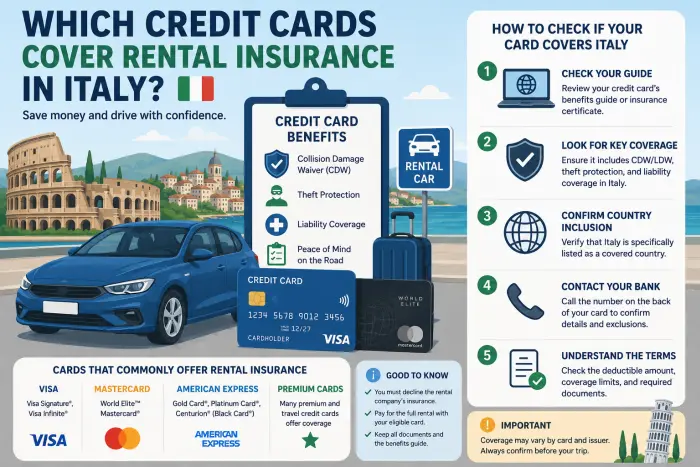
Credit card rental coverage is real and often genuinely useful, but it varies enormously by card issuer, card tier, and sometimes by which country issued the card. Here’s how to actually check what you have before deciding whether to buy anything extra at the desk.
🗂️ Bottom Line: Card-provided rental coverage falls into two types: primary (pays out first, no need to involve other insurance) and secondary (only covers what’s left after other coverage pays). Higher-tier travel cards — Amex Platinum, Chase Sapphire Reserve, Visa Infinite/Signature tiers — more commonly include primary coverage, while standard cards, if they cover rentals at all, are usually secondary. Coverage almost always requires declining the rental company’s own CDW/LDW and paying the full rental cost on that card.
For a broader look at how rental insurance in Italy works overall — including the excess/deductible your card coverage is meant to offset — see our complete car rental insurance guide for Italy.
Primary vs Secondary Coverage: The Key Distinction
This is the single most important thing to understand before assuming you’re covered:
| Coverage Type | How It Works | Practical Impact |
|---|---|---|
| Primary | Card coverage pays first, directly, without involving your personal auto insurance or other policies | Faster, simpler claims process, no impact on personal insurance history |
| Secondary | Card coverage only pays what’s left after your personal auto insurance or other applicable coverage has paid | Requires filing with your regular insurer first, can affect personal policy claims history |
Secondary coverage isn’t useless — it can still close the gap the rental company’s excess leaves open — but it means more paperwork and, for renters without a personal auto policy at home that extends to rentals abroad, secondary coverage alone might not help much at all. Note that this whole discussion assumes a credit card is being used; renters paying with a debit card typically don’t have access to this kind of built-in coverage at all.
How Major Card Networks Typically Compare
Coverage terms shift often enough that specific benefit guides should always be the final word, but as a general pattern across the market:
| Card Category | Typical Coverage Type | Notes |
|---|---|---|
| Premium travel cards (Amex Platinum, Chase Sapphire Reserve, Venture X) | Often primary | Usually the strongest built-in protection, sometimes with higher per-incident limits |
| Mid-tier travel cards (Visa Signature, World Mastercard) | Mixed — varies by issuing bank | Worth checking the specific card’s guide to benefits document |
| Standard/no-fee cards | Often none, or secondary only | Coverage, if any, tends to be minimal |
| Business/corporate cards | Frequently primary | Business-oriented cards often skew toward stronger travel protections |
Amex Platinum is one of the more thoroughly documented examples of premium-card rental coverage — our dedicated Amex Platinum rental insurance guide for Rome pickups walks through exactly how that specific coverage works in practice, which is a useful template for reading any other premium card’s terms.
The Conditions That Make Coverage Valid
Card-provided rental coverage almost universally requires a few specific conditions to be met, and missing any one of them can void the claim entirely:
- Decline the rental company’s CDW/LDW upgrade at pickup. Card coverage is meant to replace this, not stack on top of it — accepting both doesn’t double your protection, and in some cases voids the card’s coverage entirely.
- Pay for the entire rental using the covered card. Splitting payment across multiple cards, or paying a deposit on one card and the balance on another, can disqualify the claim.
- Rent for the covered maximum duration. Many cards cap coverage at a certain number of consecutive days (often 15-31 days) — longer rentals may fall outside coverage entirely past that point.
- Rent an eligible vehicle class. Luxury, exotic, and some commercial vehicle categories are frequently excluded from card coverage regardless of card tier.
What Card Coverage Usually Excludes
Even strong primary coverage tends to carve out the same handful of exclusions:
- Damage caused while driving under the influence
- Damage to tires, windshields, or the vehicle’s undercarriage
- Personal injury or medical costs (separate from the vehicle damage coverage itself)
- Rentals booked through certain third-party aggregators, in some card terms
- Rentals in specific countries occasionally excluded by name, though Italy is rarely one of them
None of these exclusions are unusual — they largely mirror what standard rental company insurance also excludes, and pairing this with a look at required pickup documents helps make sure nothing at the counter catches you off guard.
💸 Italy Car Rental Sale – Up to 40% Off Today
Find the cheapest car rental deals in Rome and across Italy. Compare prices instantly and lock in your discount before it's gone.
How to Actually Verify Your Card’s Coverage
The only reliable method is checking your specific card’s guide to benefits document, usually available through your card issuer’s app, website, or by calling the number on the back of the card. Searching “[your card name] rental car insurance guide to benefits” typically surfaces the exact PDF. It’s worth doing this before the trip, not at the rental counter with a line forming behind you — the terms are detailed enough that reading them under pressure isn’t realistic, and it pairs well with knowing what actually happens at the payment counter so nothing feels rushed.
If you’re a US cardholder specifically, our guide on rental insurance for American travelers in Italy covers some of the country-specific quirks that come up, including how US-issued card coverage sometimes differs from what the same card brand offers when issued elsewhere.
Filing a Claim If Something Happens
If damage occurs and you’re relying on card coverage, the general process looks like:
- Document everything at the scene — photos, police report if required, rental company’s own incident report
- Keep every piece of paperwork the rental company gives you, including the final invoice showing what you were charged
- Contact your card issuer’s benefits administrator (a separate department from general customer service) to open a claim
- Submit documentation within the claim window specified in your card’s terms, often 30-60 days from the incident
This is where the pre-authorized rental deposit hold matters — the rental company will typically charge the excess amount to your card first, and the card’s claim process reimburses you afterward rather than preventing the charge in the first place.
FAQ
What’s the difference between primary and secondary credit card rental coverage? Primary coverage pays directly without needing to involve other insurance first. Secondary coverage only pays what’s left after your personal auto insurance or other applicable coverage has already paid out.
Do I need to decline the rental company’s insurance to use my credit card’s coverage? Yes, in almost all cases. Card coverage is designed to replace the rental company’s CDW/LDW upgrade, not supplement it, and accepting both can void the card’s coverage.
Which credit cards typically offer the best rental car coverage? Premium travel cards like Amex Platinum, Chase Sapphire Reserve, and similar high-tier products more commonly include primary coverage with higher limits, though terms vary by issuer and should always be checked directly.
Does credit card rental coverage work the same everywhere, or does Italy have exceptions? Italy is rarely excluded by name in major card terms, but it’s still worth confirming — some cards do carve out specific countries or regions from coverage.
How long can a rental last and still be covered by credit card insurance? Many cards cap coverage at 15-31 consecutive days, varying by issuer. Longer rentals may lose coverage past that point, so check your specific card’s terms for extended trips.
What happens if I pay for part of the rental on a different card? This can disqualify the claim entirely. Card coverage generally requires the full rental cost to be charged to the one covered card, not split across multiple payment methods.
Do I still need travel insurance if my credit card covers rental car damage? Card coverage typically only covers the vehicle itself, not medical costs, trip cancellation, or other travel-related risks, so it’s not a full substitute for broader travel insurance.
Where can I find my exact card’s rental coverage terms? Check your card issuer’s “guide to benefits” document, usually available through the issuer’s app, website, or by calling the number on the back of your card.