A husband weighing in on a Rick Steves forum thread, described by his wife as having spent 40-plus years in the insurance business, gave the simplest possible advice on this whole topic: “Always take the CDW.” It’s good advice, but it also skips past the part that actually confuses people — because in Italy, CDW is already included in your rental price by default. The real decision isn’t whether to take it. It’s whether to pay extra to reduce what CDW still leaves you exposed to.
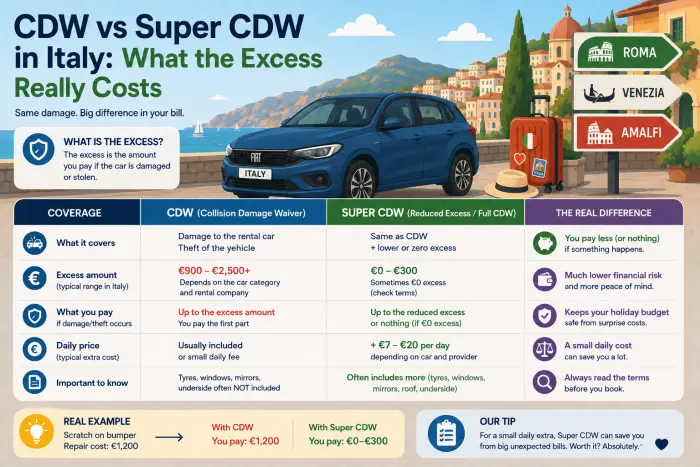
Standard CDW in Italy caps your liability at an “excess” — typically €1,000 to €2,000 — rather than eliminating it. Super CDW (also called zero-excess or full coverage) is a paid upgrade that reduces that excess to somewhere near zero, usually for an extra €10 to €55 per day. Whether that upgrade is worth it depends less on the price tag and more on what you’re comparing it against, which is where most people stop reading the fine print too early.
Why CDW alone doesn’t mean “fully covered”
Italian rental law requires every car to carry CDW and theft protection as standard — unlike several other European countries, you can’t decline it here even if you have separate coverage elsewhere. But “included” and “fully covered” aren’t the same thing. CDW limits how much you’d owe if the car is damaged; it doesn’t reduce that amount to zero. The number it caps you at — the excess — is held as a deposit on your credit card for the length of the rental, and if the car comes back with damage, that’s the amount the company can charge before you even start negotiating who’s actually at fault.
The excess, in real numbers
| Coverage tier | Typical excess if something goes wrong | Typical extra daily cost |
|---|---|---|
| Standard CDW (included in most rates) | €1,000–€2,000 | None — bundled into the rate |
| Super CDW / Zero Excess / Full Coverage | €0–€200 | Roughly €10–€55/day |
| Independent excess insurance (third-party) | Reimburses the excess after you pay it | Roughly €5–€18/day |
The middle option is what the rental counter will push hardest, because it’s the most profitable add-on in the entire transaction. The third option is the one almost nobody mentions unless you go looking for it.
What even Super CDW usually doesn’t cover
This is the detail that catches people off guard even after they’ve paid for the “full” upgrade: most CDW and Super CDW policies, standard or upgraded, still carve out glass, tires, the undercarriage, mirrors, and the roof as separate exclusions — commonly grouped under “road hazards.” Damage from driving onto a ferry, vandalism, or acts of nature can also fall outside standard coverage. If you’re picturing “zero excess” as genuinely zero risk, this is where that picture breaks — it’s zero risk for collision damage to the car’s body, not zero risk in every scenario. This connects directly to something we’ve already covered: if your rental car gets broken into, the glass and lock damage from that break-in may fall into exactly this kind of gap, regardless of which coverage tier you paid for.
The alternative almost nobody mentions at the counter
Independent excess insurance — sold by third-party providers rather than the rental company — works differently: instead of eliminating the excess upfront, you pay the excess if damage happens, then file a claim with the third-party provider to get reimbursed. It’s a genuinely different mechanism from Super CDW, and it costs meaningfully less, often a third to half the price per day. The tradeoff is that you’re fronting the money temporarily and dealing with a claims process afterward, rather than walking away from the counter with nothing to pay regardless of what happens. For a shorter trip or a lower-risk itinerary, that tradeoff is often worth the savings; for a longer trip, mountain driving, or anyone who’d rather not deal with a claim at all, the rental company’s own zero-excess option buys genuine peace of mind for a real price.
Where this leaves credit card coverage
If you were planning to rely on a credit card’s rental insurance to skip the rental company’s upsell entirely, Italy is one of the specific countries where that plan often falls apart — some cards explicitly exclude Italy, or exclude the mandatory CDW/theft structure Italian law requires, which is a different setup than what most card benefits are written around. We go deeper on this specific gap in our guide to which credit cards actually cover rental insurance in Italy — it’s worth checking before you assume your card has this handled, rather than finding out at the counter that it doesn’t apply here.
Why Italy specifically pushes this upsell so hard
Italian rental counters have a reputation, backed by repeated traveler accounts, for being among the more aggressive in Europe about pitching the upgrade — partly because Italy’s driving conditions (narrow historic streets, aggressive parking, high scratch-and-dent rates) genuinely do produce more disputed damage claims than calmer markets. That’s not necessarily a reason to buy the most expensive option out of anxiety, but it is a reason to document the car thoroughly at pickup regardless of which coverage tier you choose — photos and video of every panel, timestamped, are your actual defense in a disputed claim, arguably more useful than the coverage tier itself.
💸 Italy Car Rental Sale – Up to 40% Off Today
Find the cheapest car rental deals in Rome and across Italy. Compare prices instantly and lock in your discount before it's gone.
Theft protection is a separate line, not a CDW add-on
It’s easy to lump theft protection in with CDW since they’re often bundled together in the same sentence on a rental confirmation, but they’re covering two different risks. CDW addresses collision and physical damage to the car; theft protection addresses the car being stolen outright. Both typically carry their own excess, and both get reduced together when you upgrade to Super CDW, but it’s worth knowing they’re conceptually separate coverages stacked into one line item — useful context if you’re ever reading a claim denial and trying to figure out which part of the policy actually applies to your situation.
If a damage claim does happen
Even with the best coverage tier, a disputed claim is still a process, not an instant resolution. If the rental company charges your card for damage you believe wasn’t there, or wasn’t your fault, your first move is requesting an itemized damage report with photos from their side, then comparing it against your own pickup documentation. Whichever coverage tier you chose — company CDW, Super CDW, or an independent excess policy — that documentation is what actually resolves a dispute, not the coverage tier’s name on the contract. A well-photographed pickup with clear timestamps has settled more disputes in practice than any specific insurance product, simply because it removes the “he said, she said” element entirely.
A simple way to decide
Before saying yes to the counter upsell, it’s worth running through this in order:
- Check whether your credit card genuinely covers Italy specifically, not just “Europe” generally — read the exclusions, not just the marketing page.
- Compare the counter’s Super CDW price against a pre-booked independent excess policy — the gap is often large enough to be worth the extra step of buying it before you travel.
- Confirm what’s still excluded even under the top tier — glass, tires, and undercarriage are the ones that catch people most often.
- Photograph the car thoroughly at pickup no matter which option you choose, since documentation matters regardless of your coverage level.
Frequently asked questions ❓
Is CDW already included when I rent a car in Italy? Yes, standard CDW and theft protection are legally required and typically bundled into the base rental rate — you’re not renting without them, but they still leave you responsible for an excess if damage occurs.
What’s the difference between CDW and Super CDW? CDW caps your liability at an excess, usually €1,000–€2,000. Super CDW reduces that excess to near zero, generally for an extra €10–€55 per day.
Do I still need extra insurance if I already have Super CDW? It depends on what’s excluded. Even Super CDW commonly leaves out glass, tires, undercarriage, and mirror damage — check the specific policy rather than assuming full coverage means everything.
Is independent excess insurance a good alternative to the rental company’s Super CDW? It can be, especially for cost. It typically costs less per day, but you pay the excess upfront if damage occurs and get reimbursed afterward, rather than paying nothing at the time.
Does my credit card’s travel insurance cover rental cars in Italy? Sometimes, but Italy is a country several cards specifically exclude or handle differently due to the mandatory CDW structure — always verify with your card issuer before relying on it.
Why do Italian rental companies push the insurance upsell so hard? Italy has a higher rate of disputed damage claims than some other European markets, partly due to narrow streets and dense parking, which gives counters a strong incentive to sell the highest-margin coverage tier.