The €25-a-day quote that turns into a €400 final bill isn’t usually fraud — it’s a series of individually small add-ons that compound faster than most renters expect. Fuel policy tricks, one-way fees, a ZTL fine that shows up weeks later, an insurance upgrade accepted under mild counter pressure: none of these are secret, exactly, but they’re rarely front and center when you’re comparing prices.
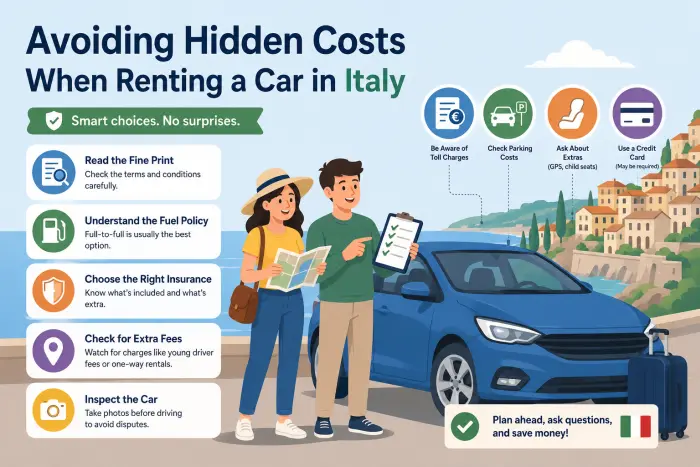
Here’s the full list of what actually gets added, and which ones are worth avoiding versus just budgeting for.
| Hidden Cost | When It Shows Up | How Avoidable |
|---|---|---|
| Fuel policy mismatch | At return, if tank isn’t at required level | Fully avoidable with a full-to-full policy |
| ZTL zone fine | Weeks/months after the trip, via camera | Avoidable with route planning |
| One-way fee | At booking, if not read closely | Predictable if checked in advance |
| After-hours surcharge | At pickup/return outside standard hours | Predictable if hours are confirmed |
| Insurance upsell | At the counter | Avoidable by deciding coverage in advance |
| Additional driver fee | At booking or counter | Predictable, budget for it |
| Young-driver surcharge | At booking or counter | Fixed cost, not avoidable under 25 |
💸 Bottom Line: The biggest gaps between quoted and final price in Italy usually come from fuel policy mismatches, ZTL zone fines issued weeks after the trip, one-way and after-hours fees, and insurance upgrades accepted at the counter rather than decided in advance. None of these are hard to avoid once you know they exist — the problem is most renters don’t know to look for them until the final bill arrives.
Insurance-related upcharges are one of the biggest single line items — our full rental insurance guide for Italy covers what’s mandatory versus optional so you’re not deciding at the counter under pressure. For a broader sense of what a rental should cost before any add-ons, see our average rental car cost breakdown by vehicle class.
Fuel Policy Tricks
This is one of the most common sources of an inflated final bill, and it comes in a few variations:
- “Full-to-full” (the fairest policy): you receive the car full and return it full. If you return it with less, you’re charged for the missing fuel, usually at a rate above pump price.
- “Half-to-full” or similar mismatched policies: you receive the car partially fueled but must return it full, meaning you’re effectively paying for fuel you didn’t fully use.
- Pre-purchased fuel plans: you pay for a full tank upfront regardless of how much you actually use, convenient but rarely the cheapest option unless you’re confident you’ll run the tank close to empty.
The safest default is confirming you have a full-to-full policy and simply returning the car with a full tank yourself, filling up at a station near the return location rather than paying the rental company’s markup rate for missing fuel.
ZTL Zone Fines
This is the cost that catches people completely off guard, because it doesn’t show up at pickup or return — it arrives weeks or months later as a charge on the card used for the deposit. Rome and many other Italian cities have ZTL (Zona a Traffico Limitato) restricted zones, monitored by camera, where driving without authorization triggers an automatic fine. Renters frequently drive through these zones without realizing it, especially near city centers, and the fine (plus a rental company administrative fee on top of the actual fine) shows up on their statement well after the trip is over.
Understanding Rome’s ZTL zone boundaries before driving into the historic center — even briefly — is the single most effective way to avoid this specific hidden cost, since it’s entirely avoidable with a few minutes of route planning before you’re behind the wheel.
One-Way and After-Hours Fees
Picking up in one location and returning in another — common for trips combining a Rome start with a different end point — typically triggers a one-way fee, sometimes disclosed clearly at booking, sometimes only surfacing when you try to finalize the reservation. Similarly, picking up or returning outside a location’s standard operating hours can trigger an after-hours surcharge, particularly relevant for late-night flight arrivals or early-morning departures.
Both fees are legitimate and disclosed somewhere in the booking process, but they’re easy to miss if you’re focused primarily on the daily rental rate rather than reading the full fee breakdown before confirming.
💸 Italy Car Rental Sale – Up to 40% Off Today
Find the cheapest car rental deals in Rome and across Italy. Compare prices instantly and lock in your discount before it's gone.
Insurance Upsells at the Counter
This is the cost most frequently cited in traveler complaints across nearly every rental company in Rome. The pattern: a quoted price that appeared to include adequate coverage turns out, at the counter, to require an additional purchase to match what the renter expected — sometimes framed with urgency or as effectively mandatory. Whether this is a genuine miscommunication or a more deliberate upsell tactic varies by situation, but the fix is the same either way: decide your insurance approach before arriving, whether that’s relying on a credit card that covers rental insurance in Italy, a pre-purchased third-party excess policy, or simply accepting the standard excess. Walking into the counter conversation with a decision already made removes most of the pressure that leads to an unplanned purchase.
Additional Driver and Young-Driver Fees
Adding a second driver to the rental agreement — a genuine requirement if more than one person will be driving — typically carries a daily fee, and drivers under 25 face a young-driver surcharge on top of the standard rate regardless of which vehicle class is booked. Neither of these is hidden exactly, but both are easy to underestimate when comparing an initial quote that doesn’t reflect your actual driver situation. Our guide on renting a car in Italy for drivers under 25 covers the young-driver surcharge specifically in more depth.
Toll Roads and Payment Method Fees
Italy’s autostrada toll system charges by distance, and while this isn’t a “hidden” cost in the sense of being unexpected, it’s frequently underestimated when budgeting a road trip — a longer highway drive can add up meaningfully compared to a route that sticks to secondary roads. Our guide to Italy’s toll roads and overview of toll payment cards for Italy cover this in more depth. Some rental companies also offer a toll transponder as a convenience add-on, priced daily, which is worth weighing against simply paying tolls manually with cash or card at exit booths for shorter trips.
A Quick Pre-Booking Checklist
- Confirm the exact fuel policy before booking, not just at pickup
- Check whether your route will pass through any ZTL zones, particularly in Rome’s historic center
- Read the full fee breakdown at booking for one-way and after-hours charges, not just the daily rate
- Decide your insurance approach in advance, whether card-based, third-party, or the rental desk’s own upgrade
- Confirm additional driver and age-related fees for everyone who’ll actually be driving
- Budget realistically for tolls if your trip includes highway driving
FAQ
What’s the most common hidden cost when renting a car in Italy? ZTL zone fines and unexpected insurance upgrades at the counter are the two most frequently reported surprises, both largely avoidable with advance planning.
How do ZTL fines show up if they’re not charged at pickup? They’re issued via camera and processed afterward, often appearing as a charge to the card on file weeks or months after the rental has ended, typically with an added administrative fee from the rental company.
Is a full-to-full fuel policy always the best option? Generally yes, for renters who plan to return the car promptly near the pickup or return location — it avoids paying above-market rates for a partial tank or an unused pre-purchased fuel plan.
Do all Italian rental companies charge a one-way fee? Most do for pickup and return at different locations, though the amount varies significantly — it’s worth checking this specific fee during the booking process rather than assuming it’s included.
How can I avoid an unexpected insurance charge at the counter? Decide your coverage approach before arriving — whether through a compatible credit card, a pre-purchased third-party policy, or the standard excess — so the counter conversation is a quick confirmation rather than an on-the-spot decision.
Are toll roads considered a hidden cost in Italy? Not exactly hidden, since they’re a known part of driving in Italy, but they’re commonly underestimated when budgeting a trip that includes significant highway driving.
Does adding a second driver always cost extra? Typically yes, a daily fee applies for each additional driver, and drivers under 25 also generally face a separate young-driver surcharge.
What’s the single best way to avoid most hidden rental costs in Italy? Reading the complete fee breakdown at booking rather than just the daily rate, and making key decisions (fuel, insurance, route planning around ZTL zones) before arriving at the counter rather than during pickup.