The first time a car flashes its headlights at you in Italy, the instinct — if you learned to drive somewhere like the UK — is to think you’re being waved through. Do the opposite. 🇮🇹 In Italy, a flash from behind means “move over, I’m coming through,” which is close to the reverse of what it signals in plenty of other countries, and it’s exactly the kind of small cultural mismatch that makes Italian roads feel more chaotic to visitors than they actually are once you know the code.
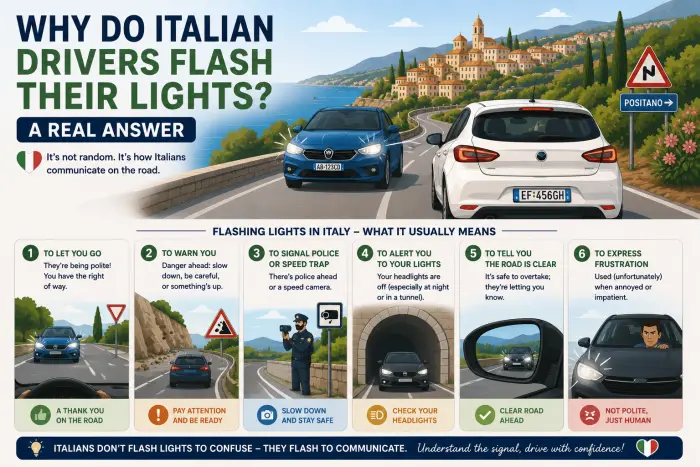
Most driving guides for Italy focus on the posted rules — speed limits, ZTL zones, toll booths — and those genuinely matter, but they’re only half the picture. The other half is a set of social conventions that every local driver absorbed growing up and that no rental agreement or road sign explains, which is exactly why a technically rule-following visitor can still feel like they’re doing something wrong every few minutes on their first drive.
🇮🇹 Decode the Road: Flashing headlights from behind means “get out of my way,” not “go ahead.” The left lane on the autostrada is strictly for overtaking — sit in it without passing and you’ll draw exactly that flashing, plus tailgating, until you move over. The horn functions as a communication tool more than an anger signal, though it’s illegal to use in urban areas except in genuine emergencies. None of this is really about aggression; it’s a different, faster-paced set of driving norms that makes more sense once you stop reading it through a foreign lens.
What Flashing Lights Actually Mean 💡
This is the single biggest source of confusion for visiting drivers, and it’s worth committing to memory before you’re on the autostrada trying to parse it in real time. A flash from a car approaching or behind you in Italy is almost always a “move” signal — get out of the lane, speed up, or make way — not a courtesy “after you” the way it can read in the UK or parts of the US. It shows up most often on the autostrada, aimed at a driver lingering in the passing lane, and it can feel aggressive the first time it happens at speed, but it’s a completely routine piece of driving communication here rather than a personal confrontation.
| Signal | What it typically means in Italy |
|---|---|
| Headlight flash from behind | “Move over” / “I’m passing, get out of the way” |
| Headlight flash from an oncoming car | Often a warning — a police check or hazard ahead |
| Short horn tap | Alert or acknowledgment, not necessarily anger |
| Prolonged horn | Genuine frustration or emergency warning |
| Hazard lights briefly tapped | “Thanks” for being let through, common in tight city traffic |
The Left Lane Rule: Not a Suggestion 🛣️
On the autostrada, the left lane exists for overtaking only, and this is enforced far more consistently in practice than the equivalent rule tends to be in the US. Sitting in the left lane after you’ve finished passing isn’t just discourteous by local standards — it’s genuinely against the rules, and it’s the single fastest way to end up with a car sitting inches off your bumper, headlights flashing, until you move back to the right. The fix is simple and worth building into habit early in your trip: pass, then move back over immediately, rather than treating the left lane as a faster cruising lane the way it sometimes functions elsewhere.
Tailgating: Common, Not Personal 🚗
Close following at high speed is a normal, if uncomfortable, feature of Italian highway driving, and it’s worth knowing in advance so it doesn’t rattle you into a panicked reaction. The instinctively safe response — braking suddenly to create space — is actually the wrong move on a fast-moving autostrada, since it increases collision risk rather than reducing it. The better approach is staying calm, maintaining a steady speed, and moving over to the right lane as soon as it’s safely possible, which resolves the situation faster than any defensive maneuver. This isn’t unique to any one visitor’s driving; it happens to confident local drivers too, and reacting with patience rather than frustration is genuinely the norm here.
The Horn as a Language, Not Just an Alarm 📯
Unlike in many countries where the horn is reserved almost entirely for genuine danger, Italian drivers use it more like a piece of everyday communication — a quick tap to say “I’m here,” “go,” or “heads up,” alongside its more familiar role expressing frustration. That said, it’s technically illegal to use the horn in urban areas except in a genuine emergency, even though enforcement of this specific rule varies. Rural roads see more open, unrestricted horn use as a general safety signal, particularly around blind curves. If you’re not sure whether a given honk is aimed at you or simply general road noise, it usually is, and it’s rarely worth taking personally.
Merging and Right-of-Way: Confidence Over Hesitation 🔀
Entrance ramps onto the autostrada tend to be shorter than what many visiting drivers are used to, which means merging requires accelerating decisively rather than waiting for a large, comfortable gap. Hesitating at the merge point is a common visitor mistake, and it tends to create more risk than committing to the merge with reasonable speed and confidence. The same principle shows up at Italian roundabouts and unmarked intersections in smaller towns, where drivers already inside generally have the right of way and expect incoming traffic to yield promptly and decisively rather than creep in tentatively. It can feel counterintuitive if you’re used to a more cautious driving culture, but matching the expected pace — while still following the actual rules — genuinely reduces friction with the traffic around you.
Rural Roads vs the Autostrada: A Different Pace 🌿
Away from the fast, dense flow of the autostrada, driving in the Italian countryside slows down considerably and feels genuinely different — narrower roads, tighter curves, and a more relaxed pace overall, even if local drivers still move with confidence. Our Rome to Tuscany road trip guide covers this shift in pace specifically for hill-town routes, where the etiquette above still applies but matters less, simply because there’s rarely a multi-lane road to navigate in the first place.
💸 Italy Car Rental Sale – Up to 40% Off Today
Find the cheapest car rental deals in Rome and across Italy. Compare prices instantly and lock in your discount before it's gone.
Things You’ll See Locals Do — But Shouldn’t Copy ⚠️
Plenty of driving habits are common enough to notice without being remotely advisable to imitate: lane-straddling between the middle and left lanes, treating stop signs as a brief pause rather than a full stop on quiet roads, and general assertiveness that borders on aggressive by visitor standards. As a rental driver, you’re held to the actual legal rules regardless of what the car next to you is doing, and Italy’s speeding fines and camera enforcement don’t discriminate between locals and tourists. Driving predictably, signaling clearly, and following posted rules — even while adapting to the faster overall pace — is the approach that keeps both your trip and your rental deposit uncomplicated.
Autostrada Basics Worth Knowing Alongside the Etiquette 📋
Beyond the unwritten social rules, a few structural things about the autostrada are worth having straight before you merge on for the first time.
| Feature | What to know |
|---|---|
| Speed | Posted limits vary by road type — our speed limit chart covers the full breakdown |
| Tolls | Most autostrade are toll roads, paid at booths by card, cash, or a prepaid transponder — see our toll roads guide |
| Roundabouts | Common on state roads and city outskirts, with their own right-of-way logic — our roundabout guide covers it |
| Drinking and driving | Italy’s limit is stricter than many visitors expect — our BAC guide has the specifics |
| Navigation | GPS handles most of this, but our navigation guide covers common app pitfalls specific to Italian roads |
Understanding both layers — the posted rules and the unwritten social ones — is what actually makes Italian roads feel manageable rather than chaotic, and it’s a large part of why so many first-time visiting drivers find the anxiety fades within the first hour or two once the pattern clicks.
Frequently Asked Questions
Why do Italian drivers flash their headlights so much? It’s primarily a “move over” or “I’m passing” signal rather than a courtesy gesture, especially on the autostrada. It can also warn oncoming drivers of a police check or hazard ahead.
Is tailgating in Italy actually dangerous, or just uncomfortable? It’s genuinely common and, while not something to dismiss entirely, the safest response is staying calm and moving right rather than braking suddenly, which increases risk rather than reducing it.
Is it illegal to use the horn in Italian cities? Technically yes, except in a genuine emergency, though enforcement varies. Rural roads see more open use as a general safety signal, particularly on blind curves.
Do I really have to stay out of the left lane on the autostrada? Yes — it’s specifically reserved for overtaking, not cruising, and lingering there is both against the rules and the fastest way to draw flashing lights and tailgating from behind.
Should I drive more aggressively to match the local pace? No — driving predictably and following the actual posted rules is the safer and more sustainable approach, regardless of what other cars around you are doing. Fines and camera enforcement apply to visitors the same as locals.
Is driving etiquette different in rural Italy versus the autostrada? Yes, noticeably — rural roads move at a slower, more relaxed pace overall, even though the same general courtesies (horn as communication, confident but predictable driving) still apply.
Will not knowing this etiquette actually get me in trouble? Not knowing it won’t get you fined, but it can make the first day or two of driving feel more stressful than it needs to be. Knowing it in advance mostly just makes the experience less jarring.
None of this is really about Italy being a harder or more dangerous place to drive — it’s a different dialect of the same basic rules, with its own signals and rhythms that make sense once you’ve seen them once. Learn the flash, respect the left lane, and stay calm through the tailgating, and the rest of an Italian road trip tends to feel considerably less intimidating than its reputation suggests.