
Rome to Siena is a straightforward two-and-a-half-hour drive up the A1, and from there the Chianti wine roads, San Gimignano’s towers, and half a dozen walled hill towns are all within an hour of each other — which is exactly why a rental car, not a train, is how most people actually see this part of Tuscany. 🍇 The catch, and it’s a real one, is that Siena and Florence both run their own camera-enforced ZTL zones, completely separate from Rome’s, and a surprising number of Rome-based road trip guides simply don’t mention it — right up until a fine shows up months later for a wrong turn near the Duomo.
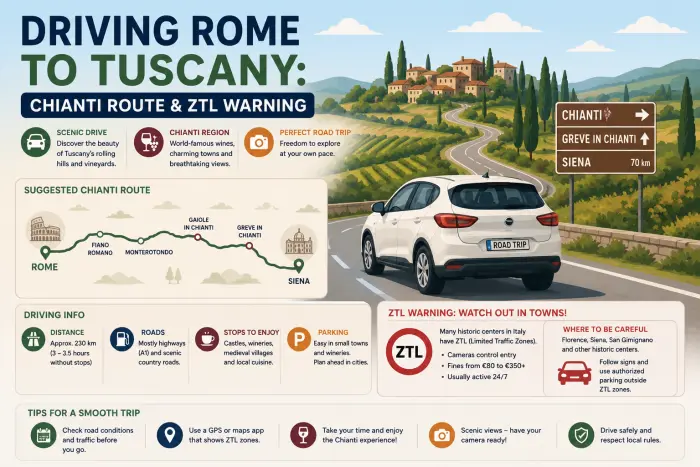
🌾 Trip Essentials: Rome to Siena runs about 230 km (140 miles) via the A1 autostrada, roughly 2.5 hours without stops. Chianti sits directly between Florence and Siena, so a loop through the wine region adds minimal detour time. Siena’s historic center has a 24/7 camera-enforced ZTL with fines around €90–100 per gate, separate from Florence’s own ZTL — park in a signed lot outside the walls at both cities and walk in. A one-way rental (Rome pickup, Florence drop-off) usually costs less in extra fees than the loop-back drive takes in time.
Is a Rental Car Actually the Right Way to See Tuscany? 🚗
Trains connect Rome to Florence quickly, but they don’t touch Chianti, San Gimignano, Montepulciano, or the smaller hill towns that make this part of Italy worth the detour in the first place — those places sit between rail lines, reachable only by a slow regional bus or a car. If your Tuscany plans involve wine estates, a specific agriturismo, or more than one hill town in a single day, a car earns its keep quickly. If you’re only after Florence itself, the train is genuinely faster and skips the parking question entirely.
| Trip style | Best fit | Rental approach |
|---|---|---|
| Rome + Florence only, no wine country | Train | Skip the rental for this leg |
| Chianti day loop from Rome | 1 long day, tight but doable | Same-day round trip, early start |
| Chianti + hill towns, 2–3 nights based in Tuscany | Most relaxed pace | Pick up in Rome, drop off in Rome or Florence |
| Multi-region Italy trip (Rome → Tuscany → Florence → onward) | One-way makes sense | Pick up Rome, drop off Florence |
The Route: What the Drive Actually Looks Like 🗺️
From Rome, the A1 autostrada runs almost due north, and the drive to Siena is mostly uneventful highway driving until you leave the motorway for the state roads that lead into Chianti proper — at which point the character of the drive changes completely. Roads narrow, curves tighten around vineyard-covered ridgelines, and the pace of the trip slows considerably, in a good way. Budget more time than a map’s estimated driving duration suggests once you’re off the autostrada; a 20-minute Google Maps estimate between two small Chianti towns routinely takes 35–40 minutes on a single-lane road behind a tractor, and that’s a feature of the region, not a problem to solve. Our toll roads guide covers what the A1 stretch will actually cost, and our speed limit chart is worth a glance since rural Tuscan roads post limits that are easy to miss at a glance among the scenery.
The ZTL Trap Nobody Mentions About Tuscany 📸
Most guides to driving in Italy focus entirely on Rome’s ZTL, which makes sense — it’s the one every tourist has heard of. What catches Tuscany-bound drivers off guard is that Siena runs a ZTL of its own, active 24 hours a day, seven days a week, covering nearly the entire historic center around Piazza del Campo, with camera gates at Porta San Marco, Porta Romana, Porta Tufi, and several others. Drive through two gates by mistake — easy to do if you circle looking for parking — and that’s two separate fines, each in the €80–130 range before the rental company’s own administrative fee gets added on top. Florence’s ZTL works similarly and is even larger, covering most of the historic center with fines that scale up further for repeat entries. San Gimignano and Montepulciano have smaller, more limited restricted zones too, but the practical fix is identical everywhere: park in a signed lot outside the walls and walk in. Every one of these towns is compact enough that the walk from an outer lot rarely takes more than ten minutes, and it removes the ZTL question entirely. Our full driving in Italy guide covers how ZTL fines get forwarded through a rental company generally, which applies the same way whether the camera is in Rome or Siena.
| Hill town | ZTL active? | Where to actually park |
|---|---|---|
| Siena | Yes, 24/7, multiple camera gates | Signed lots outside the walls (Fortezza, Il Campo car parks) |
| Florence | Yes, large zone, timed hours | Peripheral lots with shuttle or short walk; avoid driving in entirely if staying centrally |
| San Gimignano | Yes, smaller zone near the towers | Paid lots just outside the medieval walls |
| Montepulciano | Yes, limited zone at the hilltop | Lower-town lots; it’s a steep walk up, budget extra time |
| Volterra | Minimal restrictions, but very narrow streets | Park at the edge; the center wasn’t built for cars regardless of rules |
Wine Tasting and Driving: What’s Actually Legal 🍷
Chianti is wine country, and the honest answer is that Italy’s drink-driving limit is stricter than many visitors expect, with a lower threshold for newer drivers, and it applies exactly the same way on a quiet vineyard road as it does on the A1. Tasting rooms routinely pour small amounts across several wines, and it adds up faster than it feels like at the time. The practical approach most groups use: designate a non-tasting driver for the day, or space out visits so the driver tastes lightly and spits rather than swallows at each stop — a completely normal and expected practice at any serious Tuscan cantina, not something that marks you as an amateur. Our BAC guide has the specific limits and what happens if a rental driver is over them, which is worth reading before your first tasting, not after.
Gas, Tolls, and Rural Roads ⛽🛣️
The A1 toll costs a modest amount for the Rome-Siena stretch, payable by card or cash at the barrier, and it’s worth having a little cash in the car regardless — some smaller Tuscan gas stations, especially outside the main towns, are still attendant-limited or cash-preferred outside standard hours. Fuel stations thin out once you’re deep into Chianti’s back roads, so it’s worth filling up before leaving the highway rather than assuming a station will appear when the tank runs low. Our gas station guide covers the self-service process in detail, which applies identically in rural Tuscany as it does anywhere else in Italy.
Loop Back to Rome, or One-Way to Florence? 🔁
If Tuscany is a self-contained trip from a Rome base, looping back the way you came is simplest and avoids a one-way drop-off fee entirely — but it does mean driving the full A1 stretch twice. If Tuscany is one leg of a longer Italy itinerary that continues toward Florence, Venice, or further north, a one-way rental (pick up in Rome, drop off in Florence) is usually the better trade: the fee is typically a modest flat charge or a percentage of the rental cost, and it saves a genuinely tedious repeat drive back down the A1 that adds little to the trip itself. Compare this against our other one-way route breakdowns — the Rome to Bari route and the Rome to Amalfi Coast route — since the logic around one-way fees and timing is broadly similar across all three, even though the destinations are completely different.
💸 Italy Car Rental Sale – Up to 40% Off Today
Find the cheapest car rental deals in Rome and across Italy. Compare prices instantly and lock in your discount before it's gone.
Where a Tuscany Road Trip Fits Into Your Rental Decision
Everything above assumes the basics are already sorted — the right insurance for rural and hill-town driving (our insurance guide covers what a minor scrape on a narrow Tuscan lane would actually cost you), and a car booked with enough runway to compare total pricing rather than just the headline daily rate, which our day trips and route planning guide touches on for shorter Rome-based excursions. For the broader picture on renting in Rome before you commit to a Tuscany add-on, see our homepage guide.
Frequently Asked Questions
How long does it actually take to drive from Rome to Chianti? Roughly 2 to 2.5 hours to reach the southern edge of Chianti near Siena via the A1, though budget extra time once you’re on the smaller wine-road routes between individual towns, since those move much slower than the highway estimate suggests.
Can I do Rome to Tuscany as a single-day trip? It’s possible but tight — a very early start, one or two towns maximum, and acceptance that most of the day is driving rather than exploring. Most travelers get considerably more out of an overnight stay in or near Chianti rather than rushing a round trip.
Do I need a 4×4 or special vehicle for Tuscany’s country roads? No, a standard rental car handles Chianti’s paved roads without issue. Some of the more remote farm access roads to specific wine estates can be unpaved gravel, which is worth checking with the estate directly if you’re driving something low to the ground.
Is parking free outside Siena and San Gimignano’s walls? Rarely — most of the signed lots outside these historic centers charge a daily or hourly rate, though it’s a small fraction of what a ZTL fine would cost, and considerably less stressful than circling for free street parking that likely doesn’t exist near a walled center anyway.
Will my GPS warn me before I enter a ZTL zone in Siena or Florence? Not reliably. Standard GPS and phone map apps generally don’t flag ZTL boundaries, since the rules vary by city and change periodically, which is exactly why relying on signage and pre-planned parking matters more than trusting the navigation app’s suggested route into town.
Is it worth renting in Rome versus picking up a car once I reach Tuscany? For most itineraries, no — picking up in Rome means one rental covers the ZTL-heavy Rome portion, the Chianti drive, and onward travel without an extra transfer or a second rental agreement, and Rome’s airports offer considerably more car selection than smaller Tuscan pickup points.
What’s the biggest mistake people make driving from Rome to Tuscany? Driving directly into a hill town’s historic center looking for parking near the main sight, rather than using an outer lot from the start. It’s the single most common way an otherwise smooth Tuscany day turns into a ZTL fine discovered months later.
Tuscany rewards the slow version of a road trip more than almost anywhere else in Italy — a wrong turn down a cypress-lined lane rarely costs you anything beyond a few extra minutes. The one exception is the historic centers themselves, where the reward for driving in rather than parking outside is a fine, not a better view. Park at the edge, walk in, and the rest of the Rome-to-Chianti drive is exactly the kind of unhurried, scenery-first trip a rental car was made for.