The rental counter hands you the keys, points vaguely toward the highway, and that’s usually it — nobody walks you through the actual mechanics of filling up. Which is fine until you’re standing at an unmanned pump somewhere outside Orvieto at 9pm, the machine only takes cards issued in Italy or wants a PIN your foreign card doesn’t have, and you’re not entirely sure whether you’re looking at diesel or petrol.
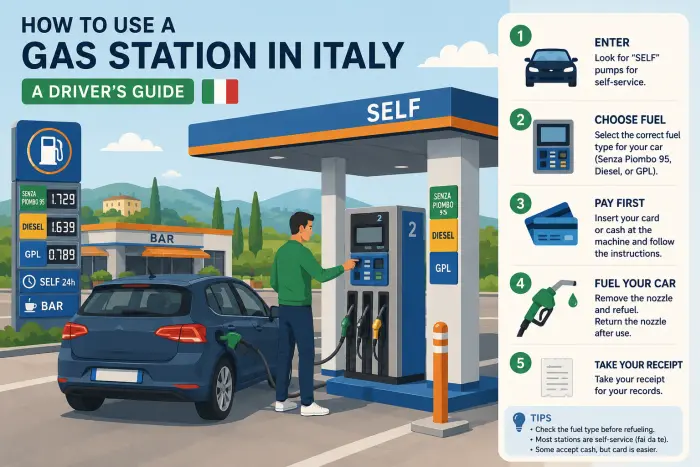
It’s a small thing that trips up a surprising number of visitors, mostly because Italian stations mix self-service and attended pumps in a way that’s not always obvious, and fuel naming doesn’t map directly onto English. Here’s the whole process broken down so the first time you do it isn’t also a stressful one.
⛽ Quick Answer: Most Italian gas stations offer both “servito” (attended, someone pumps for you, costs more) and “fai da te” (self-service, cheaper, you pump yourself). Petrol is benzina, diesel is gasolio — check your rental agreement or the fuel cap before filling, since mixing them up is a costly mistake. Payment can be by card at the pump, cash, or inside at a kiosk depending on the station.
Not sure which fuel your rental takes? It’s always printed inside the fuel cap or on the key fob — but if you’re still deciding on a vehicle, our overview of renting vs. leasing a car in Italy covers what to expect at pickup, fuel policy included.
Servito vs Fai da Te: What’s the Difference
Almost every Italian gas station gives you a choice between two service types, usually marked clearly on separate pump islands:
| Mode | How It Works | Price | Best For |
|---|---|---|---|
| Servito (attended) | An attendant pumps the fuel for you | Higher — typically 10-15% more per liter | Late at night, unfamiliar stations, when you’d rather not deal with the pump |
| Fai da te (self-service) | You select the pump, insert payment, and fill the tank yourself | Lower — the standard price most locals pay | Daytime, routine stops, cost-conscious drivers |
If you pull up to a pump with someone standing nearby ready to help, you’re likely at a servito pump and they’ll expect payment (small tip not required, but rounding up is common courtesy). If the pump area looks unattended with card readers built directly into each pump, that’s fai da te — you’re on your own, but it’s genuinely simple once you’ve done it once: select fuel type, insert card or cash, remove nozzle, fill, replace nozzle, take receipt.
Fuel Types and How Not to Mix Them Up
This is the mistake with the most expensive consequences, so it’s worth being deliberate about it:
- Benzina = petrol/gasoline (usually green pump handle/labeling)
- Gasolio or Diesel = diesel (usually black pump handle/labeling)
- GPL = LPG, a less common alternative fuel some Italian vehicles use
Rental cars in Italy run diesel more often than in some other countries, so don’t assume “gas” means the same fuel type you’re used to renting back home. Check the fuel cap itself — it’s almost always printed right there — or the rental agreement paperwork, before you approach the pump. If in doubt, ask the rental desk directly when you pick up the car; it takes ten seconds and avoids a very expensive afternoon.
Putting the wrong fuel in a rental car is treated as driver error, not a mechanical fault, and the cost of draining and flushing the fuel system (plus the tow, if the car won’t start) is typically charged directly to the renter, separate from any standard insurance or damage waiver. It’s one of the costlier and more avoidable items in our rundown of common car rental mistakes in Italy.
How to Pay at the Pump
Payment mechanics vary more than in some countries, so it helps to know the options before you’re standing there:
💸 Italy Car Rental Sale – Up to 40% Off Today
Find the cheapest car rental deals in Rome and across Italy. Compare prices instantly and lock in your discount before it's gone.
- Card at the pump (most common at larger/newer stations): Insert card, follow prompts, select fuel type, pump. Many accept international Visa/Mastercard directly, though some older machines are pickier about foreign cards.
- Pre-pay a set amount: At some self-service pumps, especially smaller rural ones, you insert cash or card first, set a fixed euro amount, and the pump stops at that amount rather than “fill to full.”
- Cash inserted directly into the machine: Common at unattended rural stations, particularly useful if a card gets declined.
- Pay inside at a staffed kiosk: At servito stations or larger complexes, you can often tell the attendant a pump number and amount, then pay inside after fueling.
If a machine rejects your card outright, it’s rarely personal — some older Italian pump terminals are picky with certain foreign card networks, particularly at night when the kiosk (if there is one) is closed and card is the only option. Keeping a bit of cash on hand for fuel stops, especially on rural or late-night legs of a trip, avoids getting stuck with an empty tank and a machine that won’t cooperate.
Highway (Autostrada) Service Stations vs Local Ones
Stations directly on the autostrada (Italy’s toll highway system) are almost always full-service, open 24 hours, and priced somewhat higher than town stations — you’re paying for convenience and round-the-clock staffing. These are the Autogrill-branded or similar rest-stop complexes most visitors will recognize, usually paired with a café and small shop. If you’re already planning a highway leg of a trip, it’s worth pairing this with our Italy toll roads guide and a look at toll payment cards for Italy, since fuel and toll stops often happen back-to-back on longer drives.
Local town and rural stations, by contrast, are a mix — some staffed during the day and self-service only overnight, some fully self-service around the clock. Prices tend to run a bit lower than highway stations, so if you have the option and the time, filling up before getting onto the autostrada is usually the better value.
Opening Hours and Sunday Closures
Smaller local stations frequently close for a midday break (common throughout Italy for small businesses generally) and may close entirely on Sundays or reduce to self-service-only hours. This is less of an issue in cities and along major routes, where stations tend to stay open longer or run 24-hour self-service pumps even when the staffed kiosk is closed. If you’re driving through smaller towns or planning a Sunday day trip — say, one of the routes in our day trips from Rome by car guide — it’s worth topping up the tank the evening before or checking that the self-service option is available at your planned stops.
Common Mistakes
- Assuming every pump is self-service. Approaching a servito pump and starting to fuel yourself can lead to confusion (and sometimes a stern word from the attendant) — check for signage or staff presence first.
- Filling with the wrong fuel type, covered above — always confirm before pumping, not after.
- Not having cash as a backup at rural or late-night stations where card readers can be unreliable.
- Forgetting the return-with-full-tank policy. Most rentals require returning the car with a full tank, and rental companies charge a steep markup for topping it up themselves — our guide on avoiding hidden rental car costs in Italy covers this along with other fees worth watching for.
- Driving distracted after a long stretch on unfamiliar roads and missing a fuel warning light, especially on rural routes where stations can be spaced further apart than expected — worth topping up earlier rather than running close to empty, similarly to how it’s worth staying alert at roundabouts after a long drive.
FAQ
What does “fai da te” mean at an Italian gas station? It means self-service — you select your fuel, pay at the pump, and fill the tank yourself, at a lower price than the staffed “servito” option.
How do I know if my rental car takes diesel or petrol? Check the fuel cap, which almost always has the fuel type printed on it, or check your rental paperwork. When in doubt, ask the rental desk before leaving.
Can I pay with a foreign credit card at Italian gas pumps? Usually yes, especially at larger or newer stations, though some older self-service machines can occasionally reject certain foreign card networks — keeping some cash as backup is a good idea.
Are gas stations open 24 hours in Italy? Highway (autostrada) service stations typically are. Local town and rural stations vary — many switch to self-service-only overnight, and some close entirely on Sundays.
What happens if I put the wrong fuel in a rental car? It’s treated as driver error. The cost of draining and flushing the fuel system, plus any towing, is typically charged to the renter separately from standard insurance coverage.
Is fuel more expensive on the highway than in towns? Generally yes. Autostrada service stations charge a premium for 24-hour staffed convenience, while local town stations tend to be cheaper.
Do I need to tip the attendant at a servito (full-service) pump? No, it’s not required, though rounding up the total to the nearest euro is common and appreciated.
Do rental cars need to be returned with a full tank in Italy? Most rental agreements require this. Returning with less than a full tank usually triggers a refueling charge at a markup, so it’s worth planning a final fill-up near the return location.