
You’re cruising down a quiet provincial road outside Orvieto, GPS chirping directions, and suddenly there it is: a roundabout with no traffic light, no stop sign, and three cars already circulating. Who goes first? Which lane should you be in? And why did the driver behind you just flash their lights at you?
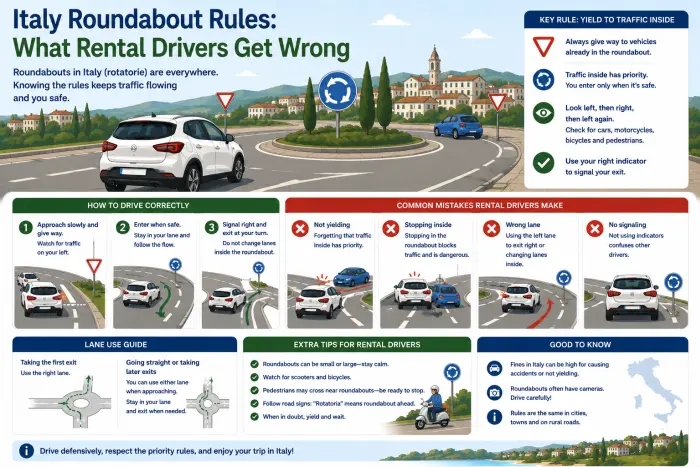
Roundabouts (rotonde or rotatorie in Italian) are everywhere once you leave the highway system — small towns use them instead of traffic lights at nearly every major intersection, and Rome’s outer ring roads have plenty too. The logic behind them is simple once it clicks, but the small habits — indicator use, lane discipline, who yields to whom — are exactly the kind of thing that never comes up in a foreign driver’s manual until they’re already in the circle.
🔄 Quick Answer: In Italy, traffic already inside a roundabout has the right of way. Vehicles entering must yield, watch for the dare precedenza (give way) triangle sign, and use their right indicator just before exiting. Multi-lane roundabouts require picking a lane based on your exit, not weaving across lanes mid-circle.
Planning to drive rural roads dotted with roundabouts on a rental? A car with strong visibility and a tight turning radius makes these junctions far less stressful — compare small and mid-size rental options in Rome before you book.
Who Has the Right of Way?
The rule in Italy is consistent and, honestly, simpler than in some other European countries: traffic already circulating inside the roundabout always has priority. If you’re approaching a roundabout, you yield — full stop — to any vehicle already in the circle, regardless of which direction it’s coming from or how far around it has to go.
You’ll usually see one of two signals confirming this at the entry point:
- A red-bordered triangle with an exclamation-style downward point (the “dare precedenza” or give-way sign)
- A “STOP” sign, less common at roundabouts but occasionally used on smaller junctions where visibility is poor
There’s no ambiguity here the way there sometimes is at four-way stops in North America. Nobody takes turns. If the circle is clear, you go. If it’s not, you wait — even if you arrived at the roundabout microseconds before the other car did.
How Italian Roundabouts Differ From Other Countries
If you’ve driven roundabouts in the UK or Ireland, the core rule (yield to circulating traffic) will feel familiar, but a few things are distinctly Italian:
- Smaller roundabouts are extremely common in town centers and rural crossroads, often replacing what would be a simple stop sign elsewhere. Don’t be surprised to hit five or six in a ten-minute drive through the countryside.
- Pedestrian crossings frequently sit right at the roundabout’s entry and exit points, and pedestrians in the crosswalk have priority over your car — even though you’re also watching for circulating traffic. Yes, this means checking two things at once.
- Locals treat roundabouts as expressways for indicator use, meaning experienced Italian drivers signal constantly and expect you to as well. Silence (not signaling) reads as unpredictable, which is when you get the flashed headlights or an impatient tap of the horn.
Single-Lane vs Multi-Lane Roundabouts
Most roundabouts you’ll meet on secondary roads and in town centers are single-lane — genuinely low-stress once you’ve done two or three. You circulate, you watch for your exit, you signal right just before you take it. Done.
Multi-lane roundabouts (common on Rome’s Grande Raccordo Anulare interchanges and larger regional junctions) add a layer of decision-making before you even enter:
| Roundabout Type | Lane Choice Rule | Typical Location |
|---|---|---|
| Single-lane | No choice — one lane, follow it around | Town centers, rural crossroads |
| Two-lane, exit in first half | Use the right/outer lane on entry | Regional junctions |
| Two-lane, exit in second half or full loop | Use the left/inner lane, then move right before exiting | Larger interchanges, ring-road junctions |
| Three-lane (rare, major interchanges) | Pick lane by signage/road markings — often color-coded arrows on approach | GRA interchanges near Rome |
The rule of thumb Italians use: pick your lane before you enter based on where you’re exiting, not once you’re already circulating. Changing lanes mid-roundabout is legal but genuinely nerve-wracking with local traffic moving at a decent clip, so it’s worth slowing down on approach to read the lane markings rather than guessing. If you’re also brushing up on posted limits before the trip, our Italy speed limit chart covers what you’ll see approaching most interchanges.
Indicator Etiquette: When to Signal, and When Not To
This trips up more foreign drivers than the right-of-way rule itself. The pattern is:
💸 Italy Car Rental Sale – Up to 40% Off Today
Find the cheapest car rental deals in Rome and across Italy. Compare prices instantly and lock in your discount before it's gone.
- Entering the roundabout: No indicator needed, unless you’re changing lanes as you enter a multi-lane one.
- Circulating: No indicator. You’re not “turning,” you’re following the curve of the road.
- Approaching your exit: Indicate right, roughly one exit before the one you’re taking (or a few seconds before, on a small roundabout).
A common foreign-driver mistake is leaving the left indicator on the whole way around to signal “I’m not exiting yet” — this isn’t standard practice in Italy and can actually confuse other drivers who expect a left signal to mean an unusual maneuver. Keep it simple: no signal until you’re about to leave.
Roundabouts With Traffic Lights
A handful of larger, busier roundabouts — especially around Rome, Milan, and Naples — have traffic lights layered on top of the standard give-way rule, usually at peak hours to manage volume. When lights are active (and they’re not always on — some only activate during rush hour), they override the normal priority rule entirely. Watch for a small light box near the entry point; if it’s lit, follow it like any other signal-controlled junction and disregard the “yield to circulating traffic” instinct. These signal-controlled junctions tend to cluster near the same restricted zones covered in our ZTL zones in Rome guide, so it’s worth reading both before a city-center drive.
Common Mistakes Rental Drivers Make
- Stopping when you don’t need to. If the roundabout is clear, you don’t have to come to a full stop at the give-way triangle — slow, check, and go. Full stops when unnecessary annoy local traffic and increase rear-end risk.
- Hesitating too long once you’ve committed. Once you enter, keep a steady pace. Sudden braking mid-roundabout because you’re unsure of your exit is one of the more common causes of minor rental-car scrapes.
- Missing the exit and trying to cut across at the last second. If you miss your exit, it’s genuinely fine (and safer) to go around again rather than cutting across lanes.
- Ignoring pedestrian crossings at the exit. Pedestrians step off the curb assuming you’ll stop for them even as you’re focused on merging traffic — don’t let roundabout tunnel vision cause you to miss them.
- Circling the roundabout while searching for parking. In town centers, this looks (and feels) worse than it is — pull over and check our Rome parking guide or, for late arrivals, the overnight parking guide rather than making extra laps.
Fines and Penalties
Right-of-way violations at roundabouts fall under Italy’s general priority-rule infractions (mancata precedenza). Depending on severity and whether the violation caused a near-miss or collision, fines typically range from around €42 to €173, occasionally with points deducted from an Italian license (foreign licenses aren’t points-deducted the same way, but the fine still applies and can follow you home via the rental company). Rental companies routinely forward traffic camera and police-issued fines to the credit card on file weeks or months after the trip, so it’s worth driving roundabouts the same way you’d drive anywhere else in Italy: attentively, not defensively-aggressive. For context on how these charges compare to other common infractions, see our breakdown of speeding fines in Italy.
Roundabouts Around Rome You’re Likely to Hit
If you’re picking up a car near Fiumicino or Ciampino and heading out toward the coast, the Castelli Romani, or northern Lazio, a few roundabout clusters come up constantly:
- The GRA (Grande Raccordo Anulare) interchanges, several of which route through multi-lane roundabouts rather than standard highway ramps
- Ostia and the coastal road junctions, where roundabouts manage beach-town traffic in summer
- Small-town centers in the Castelli Romani (Frascati, Castel Gandolfo, Albano), where nearly every intersection is a compact single-lane roundabout
None of these are difficult once you’ve done one or two — the learning curve is short, and after a day of driving outside the city center, roundabouts stop feeling like a puzzle and start feeling like the fastest way through town.
If your route from one of these roundabout clusters continues onto the autostrada, it’s worth pairing this guide with our Italy toll roads guide and a look at toll payment cards for Italy so you’re not fumbling with cash at the booth. And before a longer day trip, it doesn’t hurt to skim our guide on using a gas station in Italy — self-service pumps work differently than what many visitors are used to.
FAQ
Do I need to signal when entering an Italian roundabout? No — signaling is only expected when you’re about to exit, not when entering or while circulating, unless you’re changing lanes on a multi-lane roundabout.
Who has priority at a roundabout in Italy — the car entering or the car already inside? The car already circulating inside the roundabout always has priority. Entering traffic must yield, confirmed by the give-way triangle sign at most entry points.
Are there roundabouts with traffic lights in Italy? Yes, particularly larger and busier ones near major cities. When the light is active, it overrides the normal yield rule — treat it like any signal-controlled intersection.
What happens if I miss my exit on a roundabout? Simply continue around and take it on the next pass. Cutting across lanes at the last moment is far riskier than doing another full loop.
Do pedestrians have right of way at roundabout crosswalks? Yes. Crosswalks at roundabout entries and exits give pedestrians priority, even while you’re also watching for circulating vehicles — it requires checking both at once.
How much is the fine for not yielding at a roundabout in Italy? Right-of-way violations generally fall between roughly €42 and €173, and rental companies typically charge these to the card on file if they’re issued after the vehicle is returned.
Which lane should I use on a multi-lane roundabout? Choose your lane before entering based on your exit — outer/right lane for an early exit, inner/left lane if you’re going most of the way around, then merge right before your exit.
Are roundabouts common outside major cities in Italy? Very. Small towns and rural crossroads use them constantly instead of traffic lights or stop signs, so expect to encounter several on any regional drive.