
If a notice from your rental company shows up on your credit card statement months after your trip to Italy ended, it’s almost certainly a speeding or ZTL fine catching up with you — and understanding how that process actually works, before it happens, makes it far less alarming when it does.
Why the Fine Doesn’t Arrive Right Away
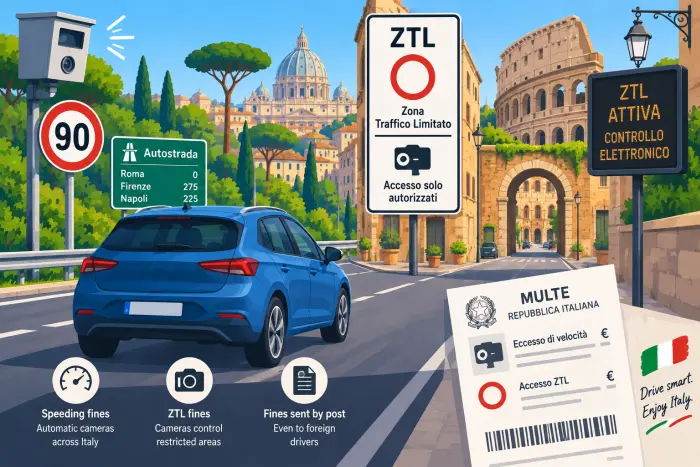
Italy’s traffic enforcement for both speed limits and restricted zones (ZTL) runs almost entirely on automated cameras — there’s no officer pulling you over in the moment, which is exactly why so many tourists drive away from a violation with no idea it happened. The camera photographs the plate, and the violation gets logged against the vehicle’s registered owner, which for a rental car is the rental company, not you. The company then has to identify who was actually driving during the relevant dates before the fine can be redirected to you specifically, and that administrative step is what adds most of the delay. Depending on the municipality’s processing speed and how the notification chain works for foreign drivers specifically, this can take anywhere from a few weeks to, in some reported cases, close to a year.
How the Charge Actually Reaches You
Once your rental company receives the official notice and confirms you were the driver on record, they’ll typically charge the fine directly to the credit card used for your rental — the same one that covered your security deposit — rather than mailing you anything to act on yourself. On top of the fine itself, the company adds its own administrative fee for handling the paperwork and forwarding your details to the authorities. This fee varies by company but commonly falls somewhere in the €30-80 range, separate from and in addition to the underlying fine.
| What arrives | What it actually is | Who charges it |
|---|---|---|
| A charge on your card with no advance warning | The fine plus the rental company’s admin fee | Your rental company |
| A formal notice by post, months later | The official government fine document | The issuing municipality or police authority |
| An early, urgent-looking payment request | Sometimes a private collection agency, not the same as an official notice | A third-party collector, not always legitimate |
ZTL Fines vs. Speed Camera Fines: Different Mechanics, Same Outcome
A ZTL violation happens the moment your plate is photographed entering a restricted zone without authorization — no warning light, no barrier, nothing stops you in the moment, which is precisely why it’s so easy to drive through without realizing it. Speed camera fines (autovelox) work the same way technically, but the threshold matters: enforcement tends to be less forgiving than many drivers assume, and a relatively small margin over the posted limit can still trigger a citation. Both violation types feed into the same billing pipeline once identified — rental company first, then you.
What to Actually Expect, Cost-Wise
Fine amounts for ZTL violations commonly land somewhere between €80 and €300 depending on the specific city, with prompt payment (generally within five days of the official notice) reducing the total, and non-payment pushing the amount higher over time. Speeding fines scale with how far over the limit you were, similar to most European countries’ structures. Add the rental company’s administrative fee on top of either, and a single unnoticed ZTL entry can end up costing meaningfully more than the fine amount alone once the admin fee is factored in.
Preventing This in the First Place
The most reliable prevention is route planning that actively routes around ZTL zones rather than assuming you’ll notice the signage in time — Google Maps and Waze both mark active ZTL boundaries, and enabling that layer before you start driving in any historic centre is worth the thirty seconds it takes. For speed limits, Italy’s posted limits (50 km/h urban, 90-110 km/h on main roads, 130 km/h on motorways, all lower in wet conditions) are enforced more consistently by camera than many drivers expect coming from countries with less automated enforcement, so treating the posted number as a hard limit rather than a rough guideline is the safer habit to build for the whole trip, not just the historic centres.
💸 Italy Car Rental Sale – Up to 40% Off Today
Find the cheapest car rental deals in Rome and across Italy. Compare prices instantly and lock in your discount before it's gone.
Our guide to ZTL zones in Rome specifically covers the city’s exact restricted areas and hours in more detail, which is worth reviewing before you pick up the car rather than after a fine already shows up.
If a Fine Does Arrive
Confirm the notice matches your actual rental dates and the plate on your agreement before assuming it’s accurate — genuine mismatches do happen, though they’re the exception rather than the rule. If everything checks out and it’s a legitimate violation, paying it directly (through whatever channel the rental company or issuing authority specifies) is generally the simplest path; if you believe there’s a genuine error, our guide to appealing a ZTL or speeding fine walks through the two formal appeal paths and when each one is actually worth pursuing.
A Few Questions Worth Asking
Can the rental company really charge my card months after I’ve returned home? Yes — the credit card authorization you agreed to at pickup typically covers exactly this kind of post-rental charge, and it’s standard practice across virtually every company operating in Italy, not specific to any one brand.
Is the rental company’s admin fee negotiable? Rarely, and it’s usually disclosed somewhere in the original rental agreement’s terms even if it’s easy to miss at the counter — it’s generally not worth disputing on its own unless the underlying fine itself is also in question.
How will I know the charge is legitimate and not a scam? A legitimate charge traces back to an actual government-issued fine tied to your specific rental dates and plate — if something feels off, contacting the rental company directly to ask for the underlying documentation is a reasonable first step before assuming fraud.
Does this affect my ability to rent from the same company again? Generally no, as long as the fine and fee are eventually paid — unpaid balances are a different matter and could affect future bookings, but a single settled fine is a routine, common occurrence that doesn’t typically follow you as a flag on your account.
Most visitors who drive in Italy never see one of these fines, and the ones who do usually trace it back to a single unnoticed ZTL entry rather than reckless driving — a little route planning before you start the engine goes further than almost anything else toward avoiding this altogether.