
Rome to Venice is a genuinely long drive — roughly 520-560 km depending on the exact route — and most planning guides stop at the distance and time. What they often skip is the detail that actually matters at the end of the trip: Venice’s historic center has no roads at all, so “driving to Venice” really means driving to the mainland, parking, and switching to a tram or boat for the final stretch.
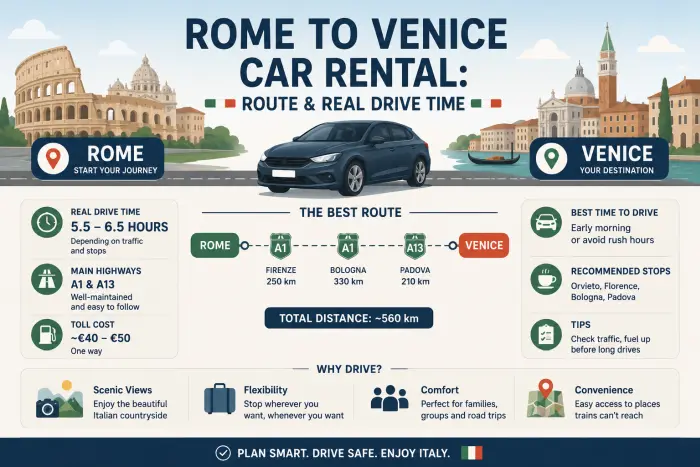
🗺️ By the Numbers: The drive covers roughly 520-560 km, primarily via the A1 north past Florence and Bologna, then the A13 and A4 into the Venice area, taking 5.5-6.5 hours including typical traffic and toll stops. Since Venice’s historic center is car-free, you’ll park at Mestre or a garage at Tronchetto or Piazzale Roma, then take a tram or vaporetto in — budget extra time for this final transition, not just the driving itself.
| Factor | Driving | High-Speed Train |
|---|---|---|
| Distance/Route | ~520-560 km via A1/A13/A4 | Direct rail line |
| Time | 5.5-6.5 hours | 3.5-4 hours |
| Reaching the historic center | Park + tram/vaporetto (extra time) | Arrives near the historic center directly |
| Best for | Trips with planned stops en route | Direct point-to-point travel |
For a genuinely honest comparison against the train, our guide on rental car vs. train from Rome covers why the train wins on this specific route for most travelers.
The Route and Realistic Drive Time
The most direct route runs via Rome’s ring road (A90) onto the A1 heading north, passing near Florence, curving around Bologna, then connecting to the A13 toward Padua before joining the A4 into the Venice area. This covers roughly 520-560 km depending on the exact path taken, with total drive time typically landing in the 5.5 to 6.5 hour range, including standard traffic and toll stops — worth padding further if you’re traveling during a peak holiday period or rush hour near the larger cities the route passes. Sticking to posted speed limits throughout matters more than usual on a drive this long, simply because there’s more distance and more opportunities for an easy mistake near unfamiliar signage.
The Part Most Guides Skip: Venice Has No Roads
This is worth understanding clearly before you plan the trip: Venice’s historic center — the canals, the bridges, the part of the city most visitors are picturing — has no roads at all. There’s simply nowhere to drive once you reach the lagoon itself. The practical result: you’ll park on the mainland, most commonly at Mestre, or in one of the parking garages at Tronchetto or Piazzale Roma (the closest vehicle-accessible points to the historic center), and then continue into the city via tram or vaporetto (water bus).
Budgeting time and cost for this final transition — parking fees, the tram or boat ride, and the walk from wherever you’re dropped — is worth doing explicitly rather than assuming the drive itself is the whole journey.
Why a Car Still Makes Sense for This Trip, Sometimes
Despite the parking complication at the end, driving genuinely adds value for specific trip structures: itineraries that include stops along the way (Orvieto, Florence, Bologna, Padua all sit reasonably close to this route), trips continuing on from Venice to other destinations not well served by train, or simply travelers who value the flexibility of their own schedule over the train’s fixed departure times. If your trip is genuinely point-to-point with no planned stops, the calculus shifts considerably toward the train instead.
Tolls and Route Costs
This route runs almost entirely on toll autostrada, and the toll cost for a drive this length is a real budget line item worth planning for rather than an afterthought. Our complete guide to Italy’s toll roads covers how the toll system works and what payment options are available, which is worth reading before a drive this long specifically.
💸 Italy Car Rental Sale – Up to 40% Off Today
Find the cheapest car rental deals in Rome and across Italy. Compare prices instantly and lock in your discount before it's gone.
Comparing This Drive to the Train
Being direct about this: for a straightforward Rome-to-Venice trip with no planned stops, the high-speed train covers the same route in roughly 3.5 to 4 hours, meaningfully faster than the 5.5-6.5 hour drive once you also account for the parking-and-transfer step at the Venice end that driving requires and the train doesn’t. This trade-off is worth weighing honestly rather than defaulting to a rental car simply because it’s the more familiar option for a long-distance trip.
One-Way Rental Considerations
If you’re picking up in Rome and returning in Venice rather than driving back, this is a standard one-way rental arrangement, generally available through most major companies with an additional one-way fee that varies by distance and specific drop-off location. Confirming this fee during booking, rather than assuming it’s included in the base rate, avoids a surprise at pickup — and it’s worth reading our rental insurance guide before a drive this long, given the distance and variety of road types involved. If your route includes any city stops along the way, it’s also worth knowing that ZTL restricted zones exist in most Italian historic centers, not just Rome’s, so the same driving caution applies if you stop in Florence, Bologna, or Padua.
FAQ
How far is it to drive from Rome to Venice? Approximately 520-560 km, primarily via the A1, A13, and A4 autostrada, depending on the exact route taken.
How long does the drive from Rome to Venice actually take? Typically 5.5 to 6.5 hours under normal conditions, including standard toll stops and traffic — longer during peak holiday periods.
Can I drive directly into Venice’s historic center? No — Venice’s historic center has no roads at all. You’ll park at Mestre or a garage at Tronchetto or Piazzale Roma, then continue in via tram or vaporetto.
Is it faster to take the train or drive from Rome to Venice? The train is generally faster for a direct trip, covering the route in roughly 3.5-4 hours compared to driving’s 5.5-6.5 hours plus the parking and transfer time at the Venice end.
When does driving make more sense than the train for this route? When your itinerary includes planned stops along the way (Florence, Bologna, Padua, Orvieto) or continues on from Venice to destinations not well served by train.
Are there a lot of tolls on the Rome-to-Venice drive? Yes, the route runs almost entirely on toll autostrada, making toll cost a meaningful part of the trip budget worth planning for in advance.
Can I return my rental car in Venice instead of driving back to Rome? Yes, through a standard one-way rental arrangement, available at most major companies with an additional fee that varies by distance and specific drop-off point.
Where exactly do I park if I drive to Venice? The main options are Mestre on the mainland, or garages at Tronchetto or Piazzale Roma, which are the closest vehicle-accessible points to the historic center.