Here’s something you don’t often hear from a car rental site: for several of the most common routes out of Rome, the train is genuinely the better choice — faster, cheaper, and considerably less stressful. That’s not a reason to skip renting a car for your Italy trip entirely; it’s a reason to be precise about which legs of a multi-city trip actually benefit from one.
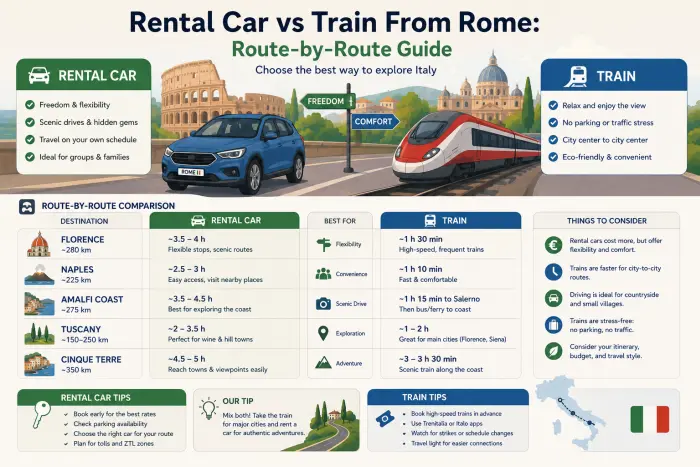
🚄 The Verdict: For city-to-city travel — Rome to Florence, Naples, or Venice specifically — Italy’s high-speed rail is faster and generally cheaper than driving, often by a wide margin (Rome-Florence runs as little as 1.5 hours by train versus 3+ hours by car with parking on top). A rental car earns its cost on the legs a train can’t cover well: countryside regions, small hilltop towns, and multi-stop day trips where flexibility matters more than raw speed.
If your trip includes both city-hopping and countryside exploring, our pros and cons of renting at all covers the broader decision this page narrows down by specific route.
Route by Route: Where the Train Wins
| Route | High-Speed Train | Driving (Realistic) | Recommendation |
|---|---|---|---|
| Rome → Florence | ~1.5 hours, from under €20 | 3+ hours incl. parking/traffic | Train, clearly |
| Rome → Naples | ~70-80 minutes, similarly priced | 2+ hours depending on route/traffic | Train, clearly |
| Rome → Venice | ~3.5-4 hours | Comparable or longer once stops/traffic included | Train, generally |
| Rome → small Lazio/Umbria towns | Often limited or no direct service | 1-2 hours, direct | Car |
| Rome → multi-stop countryside day | Not practical for combining stops | Flexible, same-day multi-stop possible | Car |
For the three major-city routes specifically, the math is fairly one-sided: Italy’s high-speed rail network connects Rome to Florence, Naples, and Venice with frequent, fast, comfortable service that a car simply can’t beat on time, and often can’t beat on total cost either once tolls, fuel, and city-center parking are added to the picture.
Where a Rental Car Genuinely Wins Instead
The routes where a car pulls ahead are, almost without exception, the ones a train doesn’t serve well in the first place: smaller towns and rural regions without convenient direct rail connections, itineraries that involve stringing together two or three stops in a single day, and destinations that are genuinely difficult to reach any other way. Our guide to day trips from Rome by car covers several specific examples — Civita di Bagnoregio being the clearest case, where even the nearest train station still requires a car or taxi for the final stretch.
Coastal road trips fall into a similar category, though with their own complications — our honest look at driving from Rome to the Amalfi Coast covers a route where a car is useful for part of the trip but genuinely not the best tool for the most famous stretch of road itself.
The Hybrid Approach Most Experienced Travelers Actually Use
This is worth stating plainly, since it’s the approach that actually reflects how most seasoned Italy travelers structure a multi-city trip: take the train between major cities, and rent a car only for the specific regional or countryside portion of the itinerary. Arrive in Rome, explore the city car-free, take the high-speed train to Florence or Naples, explore that city car-free too, and only pick up a rental car when you’re ready to head into the surrounding countryside — Tuscany, Umbria, the Amalfi Coast approach — where a car actually adds value instead of just adding parking headaches.
This approach also sidesteps one of the more specific frustrations of driving into any major Italian city center: ZTL restricted traffic zones exist in most historic centers, not just Rome’s, meaning a car you don’t strictly need for city-to-city travel is also a car you’d need to navigate carefully just to park once you arrive.
💸 Italy Car Rental Sale – Up to 40% Off Today
Find the cheapest car rental deals in Rome and across Italy. Compare prices instantly and lock in your discount before it's gone.
What the Train Doesn’t Tell You About the “Real” Cost of Driving
To be fair to the comparison, it’s worth being precise about why driving city-to-city often costs more than the headline rental rate suggests: tolls on the autostrada between major cities, fuel, and — the big one — city-center parking, which is often scarce and priced accordingly near historic centers. Our breakdown of typical rental costs by vehicle class covers the base rental price, but the city-to-city total needs those additional costs layered on top before it’s a fair comparison against a train ticket that already includes everything.
A Practical Way to Decide for Your Specific Trip
- If your next stop is a major city (Florence, Naples, Venice, Milan) with direct high-speed rail service, the train is very likely the better choice on time, cost, and convenience combined.
- If your next stop is a smaller town, rural region, or multiple countryside destinations, a car is likely to serve you better, provided you’re comfortable with Italian roads and driving conventions.
- If your trip mixes both, the hybrid approach above — train between cities, car for the countryside legs — is worth planning from the start rather than defaulting to one mode for the entire trip.
- If you’re picking up a car only for the countryside portion, consider a city-center pickup timed for when you actually need it, rather than an airport rental sitting parked during your city days.
FAQ
Is it faster to take the train or drive from Rome to Florence? The train is significantly faster — roughly 1.5 hours by high-speed rail compared to 3 or more hours driving once city-center parking and traffic are factored in.
Is driving from Rome to Naples ever worth it over the train? Generally not for the city-to-city leg itself — the high-speed train covers this route in roughly 70-80 minutes, faster than driving in most cases, though a car is useful once you’re exploring the region around Naples.
Which Rome routes actually benefit from a rental car instead of the train? Routes to smaller towns and rural regions without strong direct rail service, and itineraries combining multiple countryside stops in a single day, generally favor a car.
Is it cheaper to take the train or rent a car for city-to-city travel in Italy? Trains are often cheaper once the full cost of driving — tolls, fuel, and city-center parking — is factored in against a rental’s headline daily rate.
Can I use a mix of trains and rental cars on the same Italy trip? Yes, and this is the approach many experienced travelers use: trains between major cities, with a rental car picked up only for the regional or countryside portion of the itinerary.
Does a rental car make sense for Rome to Venice specifically? Generally the train is comparable or faster for this specific route, though a car becomes more useful once exploring destinations around Venice that aren’t well served by rail.
What costs do people forget to include when comparing driving to taking the train? Tolls, fuel, and city-center parking are the most commonly underestimated costs, since they aren’t part of the rental’s headline daily rate the way a train ticket already includes everything.
Should I rent a car for my entire Italy trip if it includes both cities and countryside? Not necessarily — many travelers find it more cost-effective and less stressful to train between major cities and rent a car only for the specific legs where driving genuinely adds value.