
A Tripadvisor thread on this exact question ran for years, with new travelers still adding replies a decade after the original post — someone approaching an open crossroads in a small Italian town, no stop sign, no light, no marking of any kind, and no idea who’s supposed to go first. It’s one of the more disorienting moments for a visiting driver, especially anyone used to the four-way stop convention in the US, where the unwritten rule is closer to “whoever got there first, or exaggerated politeness if it’s a tie.”
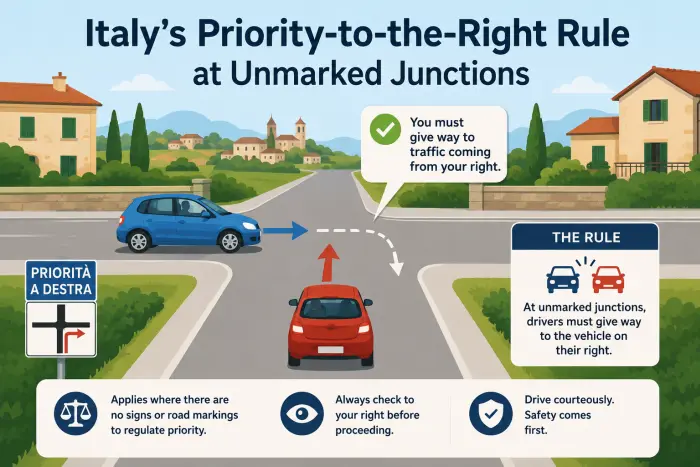
Italy doesn’t work that way. When an intersection has no signs, no signals, and no markings, the default rule is priority to the right — the car approaching from your right has the right of way, and you’re expected to yield to it, not the other way around. No negotiation, no first-come-first-served. It’s a fixed rule, and once it clicks, unmarked intersections stop being stressful.
Why this feels backwards if you’re used to American intersections 🇺🇸
A four-way stop in the US puts a physical sign at every approach, so everyone stops and takes a visible turn. Italy’s default assumes no signs are needed at all — the rule itself is the sign, baked into how driving works rather than posted at the junction. That means an intersection can look, at a glance, like nobody has priority, when in fact the rule was never absent — it just isn’t written down locally because it doesn’t need to be. This is genuinely one of the more common points of confusion cited by first-time visitors driving in Italy, right alongside interpreting a ZTL sign correctly.
This is not the same rule as a roundabout
It’s worth being explicit about this, because the two get mixed up constantly: priority-to-the-right applies at open, unmarked intersections. A roundabout runs on the opposite logic — traffic already circulating inside has priority, and vehicles entering yield to them regardless of which direction they’re approaching from. If you already know Italy’s roundabout rules, don’t try to apply that same logic here; a roundabout and an unmarked crossroads use genuinely different priority systems, and confusing the two is exactly how a “give way to the right” habit gets misapplied where it doesn’t belong.
What actually overrides the default rule
Priority-to-the-right is the fallback, not an absolute — Italian roads use signs to override it constantly, and where a sign exists, the sign wins:
| Sign or situation | What it means |
|---|---|
| Yellow diamond (“strada con diritto di precedenza”) | You’re on a priority road; crossing traffic must yield to you |
| Inverted triangle or “STOP” sign | You must yield or fully stop, regardless of direction |
| Traffic light | Overrides priority-to-the-right entirely while active |
| No signs, no markings | Default applies: yield to traffic approaching from your right |
The practical takeaway is simple: look for signage first. If you see nothing at all, that absence is itself the instruction — treat it as priority-to-the-right by default, rather than assuming an unmarked junction means no rule applies.
Narrow roads: a completely different kind of right of way
Once you’re off main roads — heading through the countryside, a hill town, or a mountain pass — a second, unrelated rule comes into play, and it has nothing to do with priority-to-the-right. On roads too narrow for two vehicles to pass safely, the vehicle closest to a pull-out, widened shoulder, or layby is expected to yield and use it, letting the other car through, regardless of which direction either car is heading or who arrived first. It’s a practical rule based on where the road physically allows a safe pass, not a hierarchy based on direction.
A commonly repeated version of local etiquette on narrow mountain roads also has the ascending vehicle get right of way over one descending, on the logic that starting again from a stop is harder going uphill — but this isn’t a strict traffic law the way priority-to-the-right is, more a courtesy convention that varies by region and driver. When in doubt, the nearest pull-out still decides who actually yields in practice, uphill logic or not. If you find yourself face to face with another car on a genuinely single-lane stretch and neither of you is near an obvious pull-out, a bit of eye contact and a wave usually resolves it faster than trying to recall the theoretical rule — this is one spot where Italian driving culture leans more toward mutual negotiation than strict enforcement.
💸 Italy Car Rental Sale – Up to 40% Off Today
Find the cheapest car rental deals in Rome and across Italy. Compare prices instantly and lock in your discount before it's gone.
Pedestrians and crosswalks add another layer
Right-of-way in Italy isn’t only about other vehicles. At a marked pedestrian crossing (strisce pedonali), pedestrians who are crossing or clearly about to step into the road have priority, and drivers are expected to stop for them — this holds regardless of whether the crossing sits at a signaled intersection or a quiet residential street. It’s a rule enforced more inconsistently than priority-to-the-right in practice, but treating every crosswalk as a hard stop rather than a suggestion is the safer default, especially in narrow historic centers where pedestrians and cars share very little space.
When the road itself keeps priority through a bend
One more wrinkle worth knowing: a road doesn’t lose its priority status just because it curves or changes direction at an intersection. If you’re driving on a marked priority road and it bends left or right at a junction, you keep the right of way through that turn — a side road merging in still has to yield to you, even though from a driver’s-eye view it might look like you’re the one turning into their path. This trips people up because it feels intuitively like whoever is “going straight through” the physical intersection should have priority, but the actual rule follows the designated priority road, not the shape of the pavement.
Emergency vehicles always come first
Regardless of any priority rule covered above, an emergency vehicle running lights and sirens — ambulance, police, fire — has absolute priority over everyone, including traffic already on a priority road or inside a roundabout. The expectation is to pull to the side and let it pass as soon as it’s safe to do so, the same instinct that applies pretty much anywhere in the world, but worth stating plainly since it’s the one rule that overrides every other rule on this page without exception.
Bringing it together on the road
None of this needs to be memorized perfectly before your trip — it needs to become instinct within the first hour of driving, which is roughly how long it takes most visitors to stop double-checking every junction. The order of checks is consistent: look for a sign first, default to yielding right if there’s genuinely nothing posted, treat a roundabout as its own separate system, and slow down automatically on any road too narrow for two-way traffic. Combined with the general orientation in our guide to driving in Rome for the first time and the broader habits covered in our autostrada etiquette guide, this covers most of what actually differs from driving back home.
Frequently asked questions
What’s the default right of way rule in Italy if there are no signs? Priority to the right. At an unmarked intersection with no signs, signals, or markings, you yield to traffic approaching from your right.
Is Italy’s right of way rule the same as a four-way stop in the US? No. A four-way stop requires every vehicle to stop and typically take turns; Italy’s priority-to-the-right rule doesn’t involve stopping unless a sign or the situation requires it — it simply determines who has priority to proceed.
Do roundabouts follow the same priority-to-the-right rule? No. Roundabouts use a separate rule: traffic already inside the circle has priority, and entering vehicles yield to it, regardless of direction.
Who has the right of way on a narrow road that can’t fit two cars? The vehicle closest to a pull-out, widened section, or layby is expected to yield and use it, letting the other vehicle pass — this is independent of the priority-to-the-right rule used at intersections.
Do pedestrians always have the right of way at crosswalks in Italy? Pedestrians crossing or about to cross at a marked crosswalk generally have priority, and drivers are expected to stop for them, even away from signaled intersections.
How will I know if a sign overrides the default priority-to-the-right rule? Watch for a yellow diamond sign, which marks a priority road, or a stop/yield sign at the intersection itself — either one overrides the default and tells you exactly who has priority.