
If your deposit is still sitting on your card three or four weeks after you returned the car clean and undamaged, you’re not imagining a problem — this is a genuinely common complaint, and it’s rarely resolved by simply waiting longer or emailing the same generic support inbox a second time. 🏦 Our deposit amounts guide covers what a normal release timeline looks like — a few days to around two weeks in most cases — so if you’re well past that window, this is the point where waiting stops being the right strategy and escalating actually is.
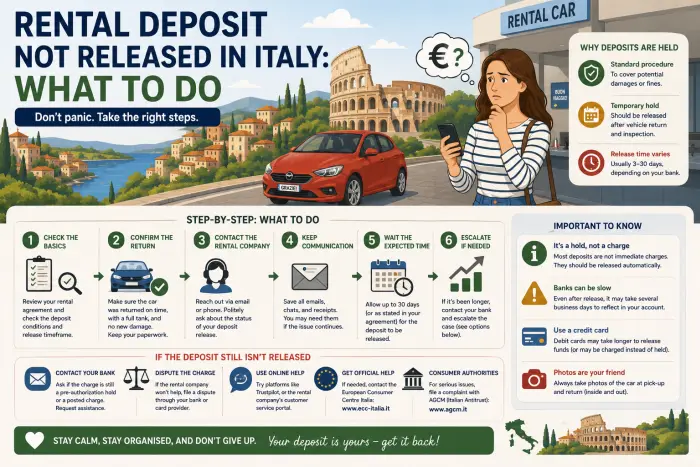
🏦 Where Things Stand: A deposit held on a credit card is an authorization, not a completed charge — these typically expire on their own under card network rules if the merchant never finalizes them, often within a few weeks, regardless of what the rental company does on their end. A deposit taken from a debit card is real money actually withdrawn from your account, which is a fundamentally different (and slower) situation to unwind. Past roughly 30 days with no release and no clear explanation, it’s reasonable to stop waiting and start escalating — first with the rental company directly, then with your card issuer if that doesn’t move things.
What “Normal” Actually Looks Like First 📋
Before assuming something’s gone wrong, it’s worth confirming you’re actually outside a normal timeline rather than just impatient a few days after return. Credit card holds typically clear within several business days to two weeks; debit card withdrawals, which are real money rather than a hold, can take longer on the refund side and vary more by bank. Weekends, bank holidays on either end, and the specific card network involved all add variability that isn’t necessarily a red flag on its own.
| Timeframe since return | What it generally means |
|---|---|
| 0–7 days | Normal — most releases happen in this window |
| 1–2 weeks | Still within typical range, especially for debit cards or during busy season |
| 2–4 weeks | Worth a direct follow-up with the rental company |
| 30+ days, no response or explanation | Time to escalate — contact your card issuer |
Credit Card vs Debit Card: Why the Fix Is Different 💳
This distinction matters more than most renters realize when something goes wrong. A credit card deposit is an authorization hold — funds are earmarked but not actually transferred, and card network rules generally require these to expire automatically if the merchant doesn’t complete the charge within a set window, often around 30 days depending on the card network and how the merchant coded the transaction. This means a credit card hold has a natural safety valve even if the rental company is slow or unresponsive. A debit card deposit, by contrast, is money that has actually left your account, and getting it back depends entirely on the rental company actively processing a refund — there’s no automatic expiration working in your favor the way there is with a credit hold. This is a big part of why our debit card rental guide leans toward recommending credit over debit specifically for the deposit, even when a debit card is accepted for payment, and it’s also why some renters look into no-deposit rental options instead, which trade a bundled insurance cost for skipping this exposure entirely.
It’s also worth separating the deposit from your insurance excess in your own head during this process, since the two get held together at some companies and separately at others — a stuck deposit dispute is a different conversation than an insurance claim, even if both show up on the same statement. If a credit card’s built-in rental protection is part of your coverage, our guide to which cards actually cover this is worth a look too, since some issuers offer more responsive support for exactly this kind of dispute than others.
Step 1: Contact the Rental Company Directly, With Proof 📧
Before involving your bank, give the rental company a clear, documented chance to resolve it — this matters both because it’s often faster and because a bank dispute is more likely to succeed if you can show you tried the direct route first. Gather your signed rental agreement, the return receipt or email confirmation showing the car was returned on time and undamaged, and any photos taken at drop-off. Send these together in a single clear message referencing your booking number, stating the date of return and the specific amount still held, rather than a vague “when will I get my deposit back” inquiry that’s easy to deprioritize. If you booked through a third-party platform like a comparison site or broker rather than directly with the rental company, loop them in too — brokers often have more leverage with the underlying supplier than an individual renter does, and some have dedicated post-rental dispute processes.
Step 2: Escalate to Your Card Issuer 🏛️
If the rental company doesn’t respond within a reasonable window after that direct request — generally another week or two — it’s time to involve your bank or card issuer rather than continuing to wait. For a credit card, ask specifically about the status of the authorization: whether it’s still an open hold or has converted into an actual posted charge, since the dispute process differs for each. An open hold that’s simply overdue to expire sometimes resolves itself once you flag it, since banks can occasionally release an aged authorization manually. A posted charge that’s genuinely wrong is a standard dispute, for which you’ll want the same documentation gathered in step one — rental agreement, return proof, and a clear timeline of your communication attempts with the rental company. For a debit card, the process is typically a “provisional credit” dispute rather than a chargeback in the credit-card sense, and banks vary considerably in how quickly they act, so being persistent and specific with your bank’s dispute department matters more here than with credit.
Real Cases: What This Actually Looks Like 🔍
Traveler reports describing this situation consistently follow a similar arc: a deposit that should have released within two weeks is still showing weeks or occasionally months later, the rental company’s support channel gives vague or repetitive responses, and resolution ultimately comes either from a persistent direct escalation with clear documentation, or from the customer’s bank stepping in once a formal dispute is filed. The common thread in cases that resolve faster is documentation gathered early and a paper trail of specific, dated follow-ups — not repeated identical emails, but escalating ones that reference the previous contact and state clearly what’s being requested next.
💸 Italy Car Rental Sale – Up to 40% Off Today
Find the cheapest car rental deals in Rome and across Italy. Compare prices instantly and lock in your discount before it's gone.
| Situation | Recommended next step |
|---|---|
| Credit hold, under 30 days, no response from company | Contact company once more with documentation, then wait for natural authorization expiry |
| Credit hold, 30+ days, converted to a posted charge | File a formal dispute with your card issuer |
| Debit withdrawal, 2+ weeks, no company response | Escalate directly to your bank’s dispute department with documentation |
| Booked via a broker/comparison site | Loop in the broker’s support alongside the rental company — they often have more leverage |
Preventing This on Your Next Rental ✅
The clearest preventive step is paying the deposit with a credit card rather than debit whenever the company allows it, given the automatic-expiration safety net credit authorizations generally have. Photographing the car thoroughly at both pickup and return, keeping every email confirmation, and getting a signed or emailed return receipt rather than just dropping the keys in a box all give you stronger footing if a dispute does become necessary later. Our rental scams guide covers related pickup and return documentation habits that make this kind of dispute far easier to win if it comes to that.
Does the Rental Company Matter Here? 🏢
Anecdotally, this pattern shows up more often with smaller local operators and third-party resellers than with the major international brands, simply because larger companies tend to have more established back-office processes for handling holds and releases at scale. That’s not a guarantee — plenty of travelers have smooth experiences with small operators and occasional frustrating ones with big names — but if avoiding this headache entirely is a priority for your next booking, our brand comparison guide is worth reviewing before you commit, alongside understanding the full payment sequence so nothing about the deposit process catches you off guard at the counter in the first place.
Frequently Asked Questions
How long is it normal to wait for a rental deposit to release in Italy? Typically a few days to around two weeks for most cases. Past 30 days with no explanation is a reasonable point to actively escalate rather than continue waiting.
Does the deposit release faster with a credit card than a debit card? Generally yes. Credit card holds are authorizations that often expire automatically under card network rules even if the merchant is slow, while debit card withdrawals require the company to actively process a refund with no automatic safety net.
Who should I contact first if my deposit hasn’t released? The rental company directly, with your rental agreement and return proof attached, referencing your booking number and the specific amount and date. Only escalate to your bank if that doesn’t produce a response within another week or two.
Can my bank help if the rental company won’t respond? Yes — for a posted charge, this is a standard dispute process; for a still-open authorization, your bank can sometimes manually release an aged hold once you flag it as overdue.
Does it matter if I booked directly with the rental company or through a comparison site? It can help to loop in the booking platform if you used one, since brokers sometimes have more direct leverage with the supplier than an individual renter negotiating alone.
What documentation actually helps in a dispute? Your signed rental agreement, proof of on-time and undamaged return (email confirmation, receipt, or photos), and a dated record of your communication attempts with the rental company.
Is a delayed deposit release connected to whether I bought extra insurance? Not directly — deposit release timing is generally about administrative processing on the company and bank side, separate from which insurance or excess-reduction coverage you purchased.
A deposit that won’t release is frustrating, but it’s rarely unrecoverable — the cases that drag on longest tend to be the ones where the renter keeps waiting instead of escalating with clear documentation. Know your timeline, know which card type you’re dealing with, and move from patience to persistence once you’re genuinely past the normal window.