Someone on a Rick Steves forum thread spent weeks worried about an “environmental sticker” they thought their German rental car might be missing before a trip through Tuscany, and mixed it up entirely with something else — the ZTL, Italy’s permit-based restricted zone. A local eventually cleared it up, but not before the traveler had spent real time solving the wrong problem. That mix-up happens constantly, and it’s an easy one to make, because both systems photograph your plate, both hand out fines, and both show up in the same historic city centers.
They are not the same thing, though, and the difference actually changes what you need to check before driving into Milan, Bologna, or a handful of smaller towns beyond Rome’s own ZTL system, which we cover separately in our guide to Rome’s ZTL zones.
A ZTL restricts who enters — permit or no permit, regardless of what your car runs on. A low emission zone restricts what kind of engine enters — Euro emissions class, regardless of whether you have a permit. Two different questions, two different answers, and driving through one system safely tells you nothing about the other.
| ZTL (Zona a Traffico Limitato) | Low Emission Zone (LEZ) | |
|---|---|---|
| What it checks | Whether you have authorization to enter | Your vehicle’s engine and Euro emissions class |
| Common examples | Rome’s centro storico, Florence’s historic center, small towns like Lucca or Orvieto | Milan’s Area B, Bologna’s winter diesel restriction |
| How you’re cleared | Hotel registers your plate, or you pay a daily pass | Your vehicle simply meets the required emissions standard, or it doesn’t |
| Typical hours | Often daytime only, varies by city | Often 24/7 or seasonal (e.g., winter months) |
| Can a permit fix it? | Yes — registration or payment grants entry | No — an older or higher-emission engine is banned outright, no fee gets you in |
What a ZTL is actually checking
A ZTL cares about authorization, full stop — it has nothing to do with what’s under the hood. Rome, Florence, and roughly 200 other Italian towns and cities run one, and the system works the same way everywhere: cameras at each entry gate photograph every plate, and unless that plate is registered (usually through your hotel) or you’ve paid a daily pass where one’s offered, you’re fined. A brand-new electric car with zero emissions gets exactly the same fine as a decade-old diesel if neither has authorization. This is the system tourists usually mean when they say “the zone that fines rental cars in Italy,” and it’s worth reading our dedicated ZTL guide if Rome specifically is your main concern.
What a low emission zone is actually checking
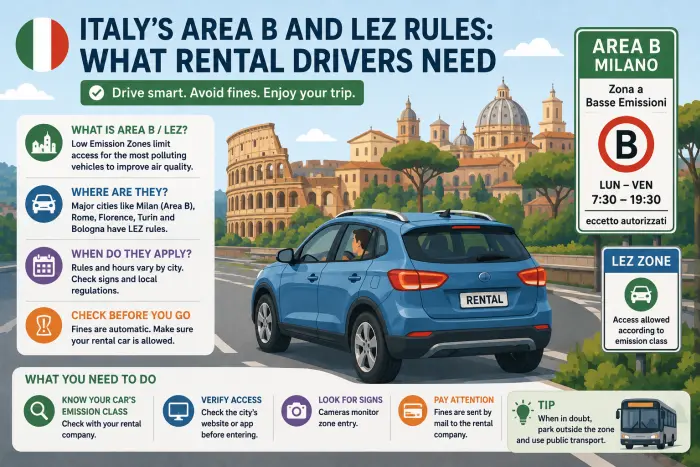
A low emission zone doesn’t care about permits at all — it cares what your engine is. Milan runs the largest and most-discussed example, Area B, which covers roughly 72% of the municipality and operates around the clock, restricting entry based on Euro emissions class rather than authorization. A car that fails the standard is banned outright; there’s no daily fee that buys its way in, unlike a ZTL. Diesel vehicles below a certain Euro class are the most common casualty, though older petrol engines can get caught too depending on the city’s specific thresholds.
Bologna adds a seasonal wrinkle worth knowing if you’re driving there in cooler months: a winter low-emission restriction targeting older diesels typically runs roughly October through April, on top of the city’s separate ZTL. Smaller towns across the country run their own local versions too, each with different thresholds and hours, so “I checked one city’s rules” doesn’t mean you’ve checked them all.
How the two fines actually reach you
Both systems are camera-enforced, and both route the fine to the rental company first, which then forwards it to you with an administrative fee added on top — that part is identical. Where they differ is timing and how the violation gets described on the paperwork. A ZTL fine typically references a specific camera gate (varco) and a timestamp, while a low emission zone fine references your vehicle’s registered emissions data matched against the zone’s restriction for that day. If a fine notice arrives months after your trip and the description doesn’t obviously say “ZTL,” it’s worth reading closely rather than assuming — it may be the other system entirely, and disputing the wrong one wastes time you don’t need to spend.
Why this trips up rental car drivers specifically
Most rental fleets skew newer, so your actual car often clears a low emission zone’s standard without any action needed — but “often” isn’t “always,” and it’s genuinely your responsibility as the driver to know the vehicle’s fuel type and emissions class, not just assume the rental company handled it. If you’re unsure, the class is on your rental documents, or a quick call to the desk clears it up before you’re relying on guesswork mid-trip.
💸 Italy Car Rental Sale – Up to 40% Off Today
Find the cheapest car rental deals in Rome and across Italy. Compare prices instantly and lock in your discount before it's gone.
The bigger risk isn’t failing the emissions check — it’s assuming that dodging the ZTL means you’ve dodged everything. A route that carefully avoids Milan’s Area C congestion charge and its ZTL-style restrictions can still run straight through Area B, since Area B’s boundary is much larger and works on a completely separate rule set.
A practical way to check before you drive
If a route takes you toward Milan, Bologna, or another mid-sized city beyond Rome — say, as part of a longer loop like the one in our Rome to Venice road trip guide — a two-minute check before you leave beats sorting it out mid-drive:
- Confirm your rental car’s fuel type and Euro emissions class from the paperwork you were given at pickup — this single detail decides whether the rest of this checklist even matters for your trip.
- Search the specific city’s low emission zone rules — each city runs its own, so a Milan search won’t tell you anything about Bologna.
- Separately check that city’s ZTL boundaries and hours, since the two systems overlap geographically but aren’t the same map.
- If either system flags your vehicle, ask the rental desk directly rather than guessing — some counters can swap you into a compliant vehicle before you leave.
Does this affect how you should choose a rental car?
If your itinerary includes Milan or a winter visit to Bologna, it’s a reasonable factor to weigh when picking between an older diesel option and a newer or electric one — not because diesel is automatically banned everywhere, but because it’s the fuel type most consistently affected across different cities’ low emission zones. If you’re already leaning electric for other reasons, our guide on charging an electric rental car in Italy is worth a look alongside this one, since an EV sidesteps the emissions-class question in most cities entirely.
None of this needs to change your itinerary on its own. Most travelers driving a reasonably modern rental car through Milan, Bologna, or a smaller town’s low emission zone never notice the system exists, because their vehicle simply clears the bar without incident. The point of understanding the distinction isn’t to worry about every city on the map — it’s knowing which question to ask if a fine ever does show up, so you’re checking the right rulebook instead of re-reading ZTL hours for a violation that has nothing to do with ZTL at all.
Frequently asked questions
Is a low emission zone the same thing as a ZTL in Italy? No. A ZTL restricts entry based on authorization — a permit or a paid pass — regardless of your car’s engine. A low emission zone restricts entry based on your vehicle’s emissions class, regardless of whether you have any kind of permit.
Does my rental car automatically meet Italy’s low emission zone standards? Often, since rental fleets tend to be newer, but not guaranteed. Check your vehicle’s fuel type and Euro emissions class rather than assuming.
Is there one national low emission zone sticker for all of Italy, like France’s Crit’Air? No. Italy has no single national scheme — low emission zones are set city by city, so a rule that applies in Milan doesn’t automatically apply anywhere else.
Which Italian city has the largest low emission zone? Milan’s Area B is the most frequently cited example, covering roughly 72% of the municipality and operating 24 hours a day.
Does avoiding the ZTL in a city also mean I’ve avoided its low emission zone? Not necessarily. The two zones can have different boundaries entirely — a route that skips a city’s ZTL can still pass straight through its low emission zone.
Are low emission zone restrictions seasonal or year-round? It depends on the city. Some, like Milan’s Area B, run continuously; others, like Bologna’s winter diesel restriction, apply only during colder months.