
Renting an electric car in Italy is more straightforward than most first-timers expect — the charging network has expanded fast, and the practical questions that actually matter (which app to use, what it costs, where to stop on a longer drive) all have clear answers. Here’s what to know before you pick up the keys.
What’s Actually in the Car When You Pick It Up
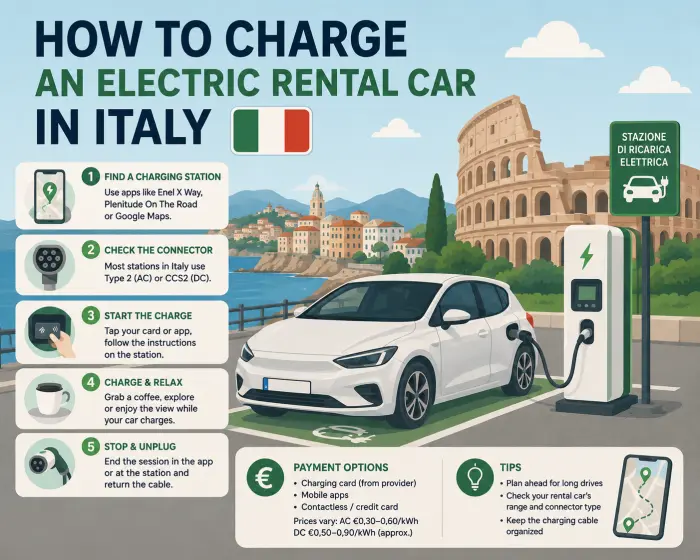
Confirm at the rental desk exactly what’s included with your specific vehicle: most rental EVs come with a Type 2 cable for standard AC charging, but not every car includes a cable for DC fast-charging stations, since many public fast chargers have their cable permanently attached. Ask specifically rather than assuming, and note the connector standard your car uses — CCS Combo 2 is the standard for DC fast charging across nearly all EVs available in Italy today, so compatibility isn’t usually the issue; having the right cable on hand is.
The Networks You’ll Actually Encounter
Italy’s public charging network has grown substantially, passing roughly 84,500 public charging points nationwide as of mid-2026. A handful of networks account for most of what you’ll actually plug into:
| Network | What It’s Known For |
|---|---|
| ⚡ Enel X Way | Italy’s largest overall network — widest general coverage, urban and rural |
| 🔵 Be Charge | Owned by Eni’s Plenitude, a major national presence alongside Enel X Way |
| 🛣️ Free To X | Autostrade per l’Italia’s own network — ultra-fast (300kW+) chargers at most major motorway service stations |
| 🌍 Ionity / Tesla Supercharger | Fill remaining gaps on key motorway corridors, often the fastest available option |
The genuinely convenient development for rental drivers: many newer fast chargers above 50kW now accept a contactless bank card tap directly at the unit, meaning you can charge without downloading an app at motorway and urban hub stations. That said, having at least one app installed is worth doing before you need it rather than fumbling with a download at the charger.
Which Apps to Actually Download
The Enel X Way app covers the largest single network and is worth having regardless of your route. For trip planning specifically — working out where to stop on a longer drive, especially through hillier terrain where range calculations get less predictable — A Better Route Planner (ABRP) is widely recommended and handles Italy’s varied terrain better than a standard maps app’s built-in EV routing. PlugShare is useful as a backup for real-time availability and other drivers’ recent reports on a specific charger’s condition, which matters more in Italy than you might expect, since occasional out-of-service units are a real if infrequent annoyance.
What Charging Actually Costs
Pricing varies meaningfully by where and how you charge:
| Where | Typical Cost |
|---|---|
| 🏠 Home-style AC charging | €0.25–€0.33/kWh |
| 🔌 Public AC stations | €0.30–€0.45/kWh |
| ⚡ Motorway fast (HPC), no subscription | €0.85–€0.95/kWh |
| ⚡ Motorway fast (HPC), with a network subscription | Around €0.39/kWh |
For a typical mid-size EV with a 60kWh battery, a full charge runs roughly €15–€20 at the cheaper AC rates, up toward €45–€55 at an unsubscribed motorway fast charger. As a rough real-world comparison, a Milan-to-Rome drive uses somewhere in the range of €50–€80 in electricity at typical rates — broadly comparable to what the same trip would cost in fuel and tolls combined for a petrol car, once you factor in Italy’s toll charges, which an EV still pays the same as any other vehicle.
💸 Italy Car Rental Sale – Up to 40% Off Today
Find the cheapest car rental deals in Rome and across Italy. Compare prices instantly and lock in your discount before it's gone.
One detail worth knowing: some networks apply a “blocking fee” if you leave your car connected after charging finishes, to keep spaces turning over — often a per-minute charge that kicks in after a grace period. It’s a minor thing, but worth moving your car promptly once charging completes, particularly at a busy motorway stop.
Charging Coverage on a Longer Road Trip
If your plans extend beyond Rome itself, coverage is genuinely solid on the major motorway corridors — the A1 (Milan–Naples), A4 (Turin–Venice), and A14 (Bologna–Bari) all have fast chargers spaced roughly 60–80km apart, largely thanks to EU infrastructure funding requirements completed in the last couple of years. Southern Italy and the islands (Sicily, Sardinia) have improved substantially too, though coverage remains thinner than the north — worth planning charging stops with slightly more margin if your route heads that direction, rather than assuming the same density you’d find around Rome or further north.
Charging in Rome Itself
Within the city, charging points are reasonably distributed across central Rome and increasingly common at hotels catering to a broader international audience — worth asking directly when booking accommodation if overnight charging matters to your plans, since a hotel with a destination charger removes the need to hunt for a public station at all during your stay. Our electric and hybrid rental guide for Rome airports covers the pickup side of things, including which rental brands at Fiumicino and Ciampino carry EVs in their fleet.
Frequently Asked Questions
Do rental EVs in Italy come with a charging cable? Usually a Type 2 cable for AC charging, but not always one for DC fast charging, since many fast chargers have a permanently attached cable. Confirm what’s included at pickup.
What connector type do Italian public chargers use? CCS Combo 2 is the standard for DC fast charging across nearly all EVs available in Italy, so compatibility with your rental car generally isn’t a concern.
Do I need an app to charge an EV in Italy? Not always — many newer fast chargers above 50kW accept a contactless bank card directly. Having the Enel X Way app installed regardless is a sensible backup, since it covers the country’s largest network.
How much does it cost to charge an EV in Italy? Roughly €0.25–€0.45/kWh for home-style or public AC charging, and €0.85–€0.95/kWh for motorway fast charging without a subscription — a full charge on a mid-size EV runs anywhere from about €15 to €55 depending on where you charge.
Is EV charging coverage reliable outside major cities? Motorway coverage is strong on the main corridors (A1, A4, A14), with chargers roughly every 60–80km. Southern Italy and the islands have thinner coverage than the north, so it’s worth planning stops with a bit more margin in those regions.
Charging an electric rental in Italy comes down to a bit of preparation rather than genuine difficulty — know your car’s cable situation, have the right app installed, and the network handles the rest. For the ZTL side of driving an EV in Rome specifically, our driving in Rome guide covers how electric and hybrid vehicles are treated differently at the restricted zones.