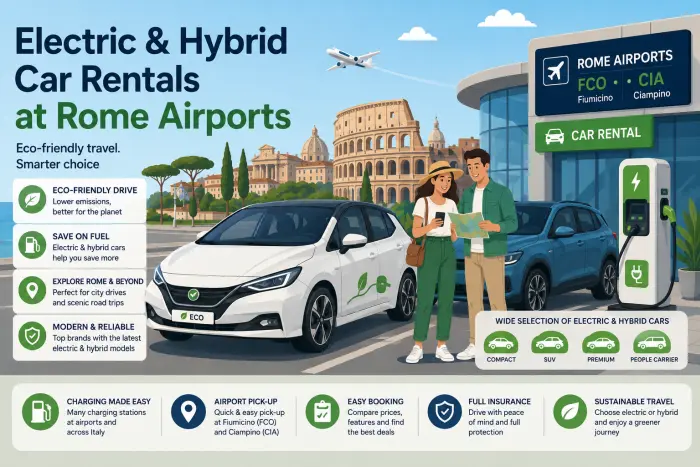
Renting an electric or hybrid car at Fiumicino or Ciampino is more available every year, and the pitch is tempting — lower running costs, quieter driving, and a car that feels current. But an EV is the right rental for some Rome trips and the wrong one for others, and the difference comes down to where you’re actually driving, not how the car sounds in the booking confirmation.
How Charging Actually Works in Italy
Unlike some countries with one dominant national network, Italy’s charging infrastructure is split across several providers — Enel X, Be Charge, IONITY, and a handful of others operate overlapping networks of public chargers, mostly accessed through an app or contactless card at the charger itself. Your rental company will walk you through how their specific vehicle handles payment, but the practical reality is that you’ll likely end up with more than one app installed if you’re charging in different regions.
The mental shift from petrol: you don’t refuel in three minutes. A rapid charger gets you a meaningful top-up in 20-40 minutes — enough for a coffee break — while a standard charger is closer to an overnight commitment. Plan around that rhythm and an EV in Rome is genuinely relaxing. Ignore it and you’ll feel range anxiety that a bit of planning would have avoided entirely.
Where an EV Actually Makes Sense in Rome
If your trip is centered on Rome itself — museums, neighborhoods, maybe a day trip to the coast or Castelli Romani — an electric or hybrid rental is arguably the smarter choice. City driving is exactly where EVs are most efficient, charging overnight at your accommodation is realistic if you’re staying more than a night or two in one place, and the quiet, instant-torque driving experience suits Rome’s stop-start traffic better than a gas engine idling at every light.
Where it gets more complicated is a longer road trip — Tuscany, the Amalfi Coast, or anywhere requiring several hours of continuous highway driving. It’s not that an EV can’t do it, but it shifts from “barely thinking about it” to “actively planning charging stops around your itinerary,” the same way any long-distance EV trip does anywhere in the world.
The ZTL Question Nobody Explains Clearly
Here’s the detail that catches a lot of EV renters off guard: driving an electric or hybrid car does not exempt you from Rome’s ZTL restrictions. ZTL zones control access by time of day and vehicle authorization, not by emissions class — a Tesla and a 20-year-old diesel are treated identically by the cameras if neither has a permit to be there. This is a genuinely common point of confusion, since electric vehicles often do get preferential treatment in Italy’s separate low-emission zones (LEZ), which work on emissions class rather than time-based access. Our ZTL vs LEZ comparison breaks down exactly which rule applies where, and our guide to Rome’s ZTL zones covers what to actually avoid regardless of what’s under the hood.
Cost: EV vs Petrol vs Hybrid
| Electric | Hybrid | Petrol | |
|---|---|---|---|
| Running cost | Lowest per km, especially overnight charging | Lower than petrol, no charging required | Highest per km |
| Rental rate | Often higher | Comparable to petrol | Often the cheapest headline rate |
| Refuel time | 20 min to several hours | Minutes | Minutes |
| Best for | City-based trips, overnight charging access | Travelers who want savings without charging logistics | Long tours, tight schedules |
The running-cost math usually favors electric, but the rental rate can offset some of that saving, and the time cost of charging is real if your itinerary is packed. A hybrid splits the difference — no charging to plan, meaningfully better fuel economy than a standard petrol car, particularly in the stop-start driving that defines central Rome.
💸 Italy Car Rental Sale – Up to 40% Off Today
Find the cheapest car rental deals in Rome and across Italy. Compare prices instantly and lock in your discount before it's gone.
What You Can Actually Rent
Rome’s airport rental fleets have broadened well past a single EV model. Expect small electric hatchbacks well suited to narrow city streets and tight parking, mid-size options with more range for mixed city-and-day-trip use, and a smaller number of premium electric models at the top end. Hybrids are more widely available across nearly every vehicle class, from compacts up through SUVs, which makes them the easier “lower running cost” choice if you’re not ready to commit to charging logistics on your trip. As with any rental, the practical advice holds: pick the smallest vehicle that comfortably fits your group and luggage rather than sizing up for range you likely won’t need on a Rome-based trip.
Rome’s Streets and Hills: Where Electric Actually Helps
Central Rome isn’t as hilly as some Italian cities, but the terrain around neighborhoods like Gianicolo, Monteverde, and the approach to some of the surrounding hill towns does involve real inclines, along with the cobblestone streets (sampietrini) that define much of the historic center. An electric motor’s instant torque makes those hill starts and stop-start crawls through narrow streets noticeably smoother than managing a clutch or hunting for the right gear on uneven cobblestones — small things, but they add up over a week of city driving. The narrower footprint of most electric compacts also helps on streets that weren’t designed with modern cars in mind, regardless of powertrain.
At the Rental Desk
A few things worth confirming specifically for an EV or hybrid pickup, beyond the standard documents every renter needs:
- The car’s real-world range, not just the manufacturer’s rated figure — ask the counter staff directly rather than relying on the dashboard estimate alone for trip planning.
- How charging is paid for — some rental companies include a charging card or app credit, others expect you to set up your own account with a local provider.
- What charge level the car must be returned at. Many companies expect the battery returned at the same percentage it was picked up at, similar to a full-tank policy for petrol cars, and charge a fee if you return it lower.
- Whether a charging cable is included and what connector type it uses, since not every public charger in Italy uses the same plug standard.
Insurance and inspection at pickup work the same way regardless of powertrain — our rental insurance guide for Italy covers what’s included by default and where the gaps typically are.
Frequently Asked Questions
Is it worth renting an electric car at Rome airport? For a Rome-based trip with overnight charging access, yes — lower running costs and a genuinely pleasant driving experience in city traffic. For a long road trip with a tight schedule, a hybrid or petrol car may be the simpler choice.
Does an electric car get special access to Rome’s ZTL zones? No. ZTL restrictions are based on time and authorization, not emissions class, so an EV faces the same restrictions as any other vehicle without a permit.
Is a hybrid a better choice than a full EV for visiting Rome? Often, yes, if you want lower fuel costs without planning charging stops. A hybrid refuels like a normal petrol car while still cutting running costs, particularly in city driving.
How long does charging take for a rental EV in Italy? Roughly 20-40 minutes at a rapid charger for a meaningful top-up, up to several hours on a standard charger. Rapid charging works well as a planned break; standard charging is better suited to overnight stops.
Do I need a specific app to charge a rental EV in Rome? Likely yes, and possibly more than one, since Italy’s charging network is split across several providers rather than a single unified system. Your rental company can point you to the specific app or card that works with your vehicle.