Comparing prices across platforms gets you a fair market rate. Actually lowering that rate further comes down to a handful of specific choices — vehicle type, rental length, transmission, pickup location — each with a real, quantifiable effect on the final price. Here’s what actually moves the number, ranked roughly by impact.
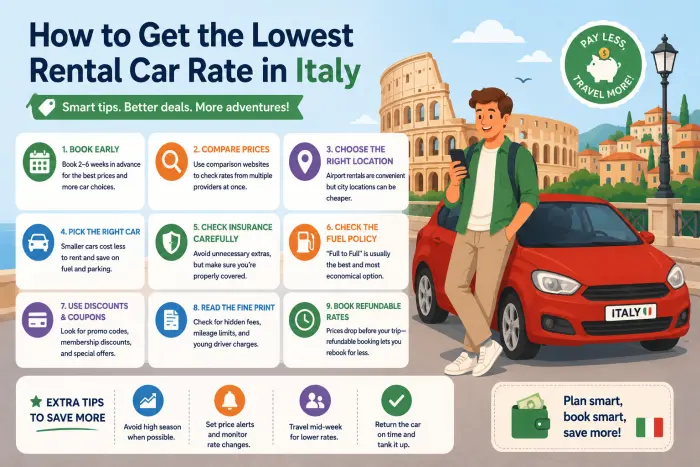
💰 The Playbook: The highest-impact levers are choosing a manual transmission over automatic (roughly 10-15% cheaper), booking a 5-7 day rental instead of 2-3 days (weekly pricing structures favor longer bookings), and picking up from a less central or off-airport location where fleet competition is higher. Prepaying often unlocks a lower rate than pay-at-counter, but trades away flexibility — worth weighing against your certainty about the trip.
| Tactic | Typical Impact | Trade-off |
|---|---|---|
| Manual instead of automatic | ~10-15% lower daily rate | Requires manual driving comfort |
| 5-7 day rental instead of 2-3 | Lower effective daily rate | Only saves if the extra days are usable |
| Off-airport/city-center pickup | Often lower base rate | Added transport time/cost to reach it |
| Prepay instead of pay-at-counter | Frequently cheaper | Less flexibility to cancel/modify |
| Right-sized vehicle class | Avoids costly counter upgrade | Requires honest assessment of actual needs |
| Minimal add-ons | Avoids daily extra fees | Requires planning ahead (own GPS/child seat) |
This pairs directly with the comparison process covered in our guide on finding the best car rental deal in Rome — that’s about comparing offers, this is about which specific choices make any given offer cheaper.
Manual vs Automatic Transmission
This is one of the more reliable levers available: automatic transmission vehicles in Italy typically carry a 10-15% price premium over an equivalent manual, reflecting the fact that manual remains the default and most widely available option across the national fleet. If you’re comfortable driving manual, this alone is a meaningful and consistent saving across nearly every vehicle class and company. If an automatic is a genuine requirement, it’s worth booking further in advance than you otherwise might, since automatics are also in shorter supply, particularly during summer.
Rental Duration Sweet Spots
Pricing structures in Italy are generally built around weekly minimums, meaning a 5-7 day rental typically produces a noticeably lower effective daily rate than a 2-3 day booking for the identical vehicle. If your trip is flexible by even a day or two, checking whether stretching to 5-7 days brings the total cost down — even accounting for the extra day or two you might not strictly need the car — is worth the quick comparison. Our breakdown of average costs by vehicle class covers this dynamic in more depth, including why single-day rentals in particular carry the highest effective daily rate of all.
Prepay vs Pay-at-Counter
Most booking platforms offer both a prepaid rate (charged in full at booking) and a pay-at-counter rate (charged at pickup, often with free cancellation). Prepaid rates are frequently priced lower, sometimes meaningfully so, in exchange for reduced flexibility — canceling or modifying a prepaid booking often comes with a penalty or isn’t possible at all, unlike a free-cancellation pay-at-counter rate.
The trade-off worth weighing: if you’re highly confident in your travel dates and plans, prepaying captures the lower rate with minimal risk. If there’s real uncertainty about the trip proceeding as planned, the flexibility of a pay-at-counter, free-cancellation rate is often worth the price difference, especially when combined with the rebooking strategy of monitoring for a lower price before the trip.
Pickup Location Trade-offs
Airport pickup locations, while convenient, often carry higher rates than off-airport or city-center alternatives, reflecting the airport’s overhead and captive-audience pricing dynamics. If your itinerary allows for it, comparing an airport pickup against a city-center option — particularly for travelers not needing the car immediately upon arrival — can surface a genuinely lower rate, though it needs to be weighed against the added transport time and cost of reaching that alternative location.
Vehicle Class: Right-Sizing, Not Just Downsizing
The obvious tactic — book the smallest vehicle class — isn’t always the actual lowest-cost choice once you factor in the whole trip. A vehicle too small for your luggage or group can mean an unplanned, expensive upgrade at the counter, which typically costs more than simply booking the right size from the start. The more effective approach is right-sizing: booking the smallest vehicle class that genuinely fits your actual trip, rather than reflexively choosing the cheapest listed option and hoping it works out.
💸 Italy Car Rental Sale – Up to 40% Off Today
Find the cheapest car rental deals in Rome and across Italy. Compare prices instantly and lock in your discount before it's gone.
Minimizing Add-Ons
Optional extras — GPS, child seats, additional drivers, prepaid fuel plans — are priced separately and add up quickly if selected reflexively rather than deliberately. A few worth reconsidering by default: a smartphone with offline maps often replaces a paid GPS rental entirely; bringing your own compliant child seat, where practical, avoids a daily rental fee; and understanding Italy’s fuel policy options before accepting a prepaid fuel plan helps avoid paying for fuel you don’t end up using. If a driver under 25 will be behind the wheel at any point, factor the young-driver surcharge into the total from the start, since it applies regardless of which other tactics you use, and it’s worth confirming your insurance approach in advance too, since an unplanned counter upgrade can undo any savings from the tactics above.
Stacking Tactics Together
None of these tactics work in isolation as well as they do combined. A manual, mid-size vehicle booked for a full week, picked up off-airport, with a free-cancellation rate monitored for price drops before the trip, will consistently beat a single-lever approach like just picking the cheapest-looking daily rate. Treating cost reduction as a stack of small, compounding choices — rather than one silver-bullet tactic — is the realistic way this actually plays out for renters who consistently pay less than average.
FAQ
How much cheaper is a manual transmission car than an automatic in Italy? Typically around 10-15% less per day, reflecting Italy’s default preference for manual vehicles and their wider availability.
Is it cheaper to rent a car for a week than for a few days in Italy? Generally yes. Weekly pricing structures typically produce a lower effective daily rate than short 2-3 day bookings for the identical vehicle.
Should I prepay for my rental car or pay at the counter? Prepaying is often cheaper but reduces flexibility to cancel or modify. Pay-at-counter with free cancellation is worth the price difference if there’s meaningful uncertainty about your travel plans.
Is picking up a rental car at the airport always more expensive than other locations? Often, yes, reflecting airport overhead and demand, though this needs to be weighed against the convenience and added transport cost of an off-airport alternative.
Does booking the smallest available vehicle always save money? Not necessarily. A vehicle too small for your actual needs can lead to an expensive counter upgrade, which often costs more than simply booking the right size initially.
What optional add-ons are worth skipping to save money? GPS (if a smartphone with offline maps works instead), a rental child seat (if bringing your own is practical), and prepaid fuel plans (if you’re confident you’ll return the tank close to full) are common places to trim cost.
Can I combine several of these cost-reduction tactics at once? Yes, and doing so consistently produces better results than relying on a single tactic — the effect of stacking manual transmission, a full-week rental, and off-airport pickup compounds meaningfully.
Does the lowest daily rate always mean the lowest total cost? Not always — it’s worth checking that a low daily rate isn’t offset by a higher deposit, mandatory add-on, or restrictive cancellation policy that increases the effective total cost.