Almost every booking site explains Italy’s two main fuel policies in the same generic paragraph — full-to-full versus pre-purchase — and then stops well short of the part that actually costs people money. ⛽ The real question isn’t which policy sounds better in the abstract; it’s what happens at the counter if you return the car anything less than exactly full, and how much that specific shortfall actually costs versus what a normal fill-up would have.
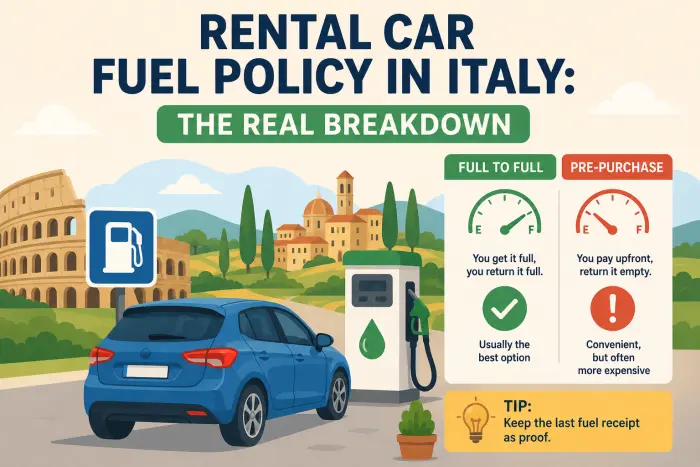
⛽ Bottom Line: Full-to-full means you pick up and return the car with a full tank, paying only for the fuel you actually use at a normal pump price. Pre-purchase means you pay for a full tank upfront, often with a partial refund for what’s left, whether or not you actually use it all. The real cost risk sits with full-to-full: return the car even slightly under a full tank, and most companies charge a refill fee at a rate well above the pump price, sometimes bundled with a flat administrative charge regardless of how little fuel was actually missing.
The Two Policies, Without the Sales Pitch 📋
Full-to-full is the policy most experienced renters prefer, and for good reason — you only ever pay for fuel you personally put in the tank, at whatever the pump charges. The trade-off is that it puts the responsibility on you to find a station and refill completely before returning the car, which works fine if you know your return route but adds a small logistical task at the end of a trip when you’re often thinking about other things. Pre-purchase flips that trade-off: you pay upfront for a full tank at booking or pickup, and you’re not responsible for refilling before drop-off — but you’re also paying for fuel whether you use the full tank or not, and while many Italian rental companies do offer a partial refund for unused fuel, it’s rarely calculated at a rate as favorable as simply buying it yourself would have been.
| Full-to-full | Pre-purchase | |
|---|---|---|
| You pay for | Only fuel you actually use, at pump price | A full tank upfront, refund for unused varies |
| Your responsibility | Refill completely before return | None — return with any amount |
| Best for | Confident about your return route and timing | Tight schedules, early or late returns |
| Biggest risk | Refill fee if you don’t quite make it to full | Overpaying for fuel you don’t end up using |
What Actually Happens If You Don’t Return It Full 💸
This is the part most booking sites gloss over. Under a full-to-full policy, a car returned with anything less than a completely full tank typically triggers a refill charge — and that charge is rarely just “market price plus a small markup.” Many companies charge a flat per-liter rate noticeably above what you’d pay at any actual station, sometimes combined with a separate administrative or service fee on top, regardless of whether the tank was nearly full or genuinely low. In practice, this means returning a car just a few liters short of full can cost meaningfully more than the fuel itself would have, simply because of how the shortfall fee is structured rather than the actual amount missing.
Finding Fuel Close to Your Return Point 🗺️
The practical fix is straightforward: know where the last convenient gas station is relative to your specific return location before you’re actually driving there, rather than hoping one appears along the way. Airport returns generally have at least one station within a reasonable distance of the rental return area, though it’s worth confirming rather than assuming, particularly for early-morning or late-night returns when hours matter. Our gas station guide covers the self-service process itself, and if your return happens to fall very early, our early return guide is worth checking too, since fuel station hours and staffing both shift at that time of day.
Is Pre-Purchase Ever the Better Choice? 🤔
Despite full-to-full generally being the better value, pre-purchase genuinely makes sense in specific situations: a very early flight where finding an open station on the way to the airport is a real risk, an unfamiliar return route where the timing feels tight, or simply a preference for one less logistical task at the end of a trip. If your schedule has any real risk of missing a station before return, the pre-purchase premium can be a reasonable trade for certainty — the honest calculation is comparing that premium against the refill fee risk under full-to-full, not assuming one policy is always right.
Does This Interact With Your Deposit? 💳
A fuel shortfall charge under full-to-full is typically deducted from your held deposit rather than billed separately, which is one more reason a fuel dispute can feel tangled up with a deposit release delay if the two get processed together. Keeping your own fuel receipt from your last fill-up, alongside a photo of the fuel gauge at return if possible, gives you the same kind of documentation that helps with any other rental dispute — proof of what you actually did, in case the company’s assessment doesn’t match your own.
Is a Confusing Fuel Policy Ever a Sign of Something Worse? 🚩
Occasionally, an unusually aggressive or unclear fuel policy is one thread in a broader pattern worth watching for — our rental scams guide covers related counter-pressure tactics, and it’s worth knowing that a legitimate, well-run rental company generally explains its fuel policy clearly at pickup rather than leaving it as a surprise at return. If something about the explanation feels evasive or inconsistent with what you booked online, it’s worth asking for it in writing before you drive off, the same way you’d confirm any other unclear charge.
💸 Italy Car Rental Sale – Up to 40% Off Today
Find the cheapest car rental deals in Rome and across Italy. Compare prices instantly and lock in your discount before it's gone.
Does Company Size Affect Fuel Policy Fairness? 🏢
Larger, well-established rental brands generally apply fuel policy charges more consistently and transparently than smaller operators, simply because standardized processes are part of running a large fleet at scale. That’s not a universal rule, but it’s a reasonable factor to weigh alongside price when comparing options through our brand comparison guide — a slightly higher rate from a company with a clearer, more consistently enforced fuel policy can be worth more than it first appears once you factor in the risk of an inflated shortfall fee elsewhere. Confirming the fuel policy is also a natural part of the broader payment process at pickup, worth reviewing alongside your deposit and insurance terms rather than treating it as a footnote.
| Rental type | Typical fuel policy clarity |
|---|---|
| Major international brand, airport location | Generally clear, consistently enforced |
| Smaller independent operator | More variable — worth confirming details directly |
| Third-party broker booking | Confirm which policy applies with the actual supplier, not just the listing |
Frequently Asked Questions
Which fuel policy is cheaper in Italy: full-to-full or pre-purchase? Full-to-full is generally cheaper if you’re confident you can refill completely before returning the car, since you only pay pump price for what you actually use. Pre-purchase can end up costing more if you don’t use the full tank.
How much does it cost if I return the car without a full tank? It varies by company, but the rate is typically well above the normal pump price, sometimes combined with a separate administrative fee — worth checking your specific rental agreement’s fuel terms before you drive off.
Do I get a refund for unused fuel under a pre-purchase policy? Many Italian rental companies offer a partial refund, but the rate is rarely as favorable as simply buying only what you use under full-to-full. Terms vary by company, so it’s worth checking at booking.
Is it hard to find a gas station before returning a rental car in Italy? Not usually near major airports or cities, but it’s worth confirming the closest station to your specific return point in advance, especially for very early or late returns when hours may be limited.
Does a fuel shortfall charge come out of my deposit? Typically yes — it’s usually deducted from your held deposit rather than billed as a completely separate charge, which is worth knowing if you’re also tracking your deposit release timeline.
Can I dispute a fuel charge if I’m sure I returned the car full? Yes, the same way you’d dispute any other charge — a photo of the fuel gauge at return and your last fill-up receipt give you real documentation to push back with if the company’s assessment doesn’t match yours.
Is pre-purchase ever worth it even though it usually costs more? Yes, specifically if your schedule has real risk of not finding an open station before an early or tight return — the certainty can be worth the premium in that specific situation.
Fuel policy is one of the more avoidable extra costs in an Italy rental, and the fix is almost entirely about planning rather than luck — know your policy, know your last fuel stop before return, and the whole question stops being a source of last-minute stress at drop-off.