
This is one of the most consistently asked questions from parents planning an Italy trip, and it’s been asked in almost identical form on travel forums for well over a decade — a sign that the answer never quite becomes common knowledge. Part of the confusion is genuine: Italy’s rule isn’t based on age the way many parents expect, and there’s a specific, lesser-known requirement that catches even careful planners off guard.
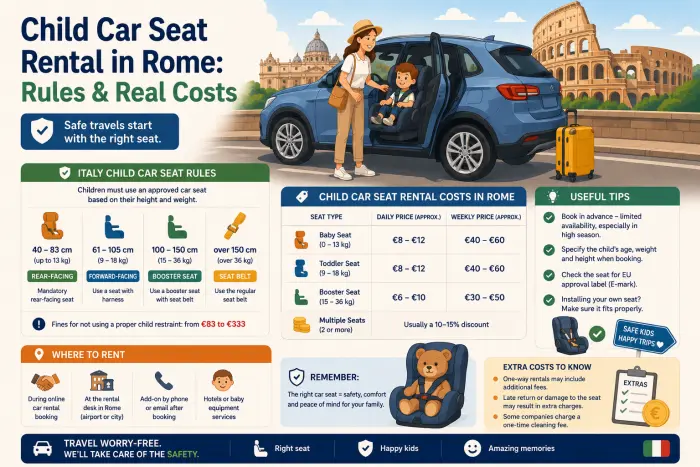
🧸 Parent’s Checklist: Italy’s child restraint law is based on weight and height, not age — children under approximately 36 kg or 150 cm must use an appropriate car seat or booster, with infants under 9 kg required to be rear-facing. Fines for non-compliance run €83 to €332, with repeat offenders facing license suspension. Since 2020, Italy has also required an anti-abandonment device (a sensor that alerts if a child under 4 is left in the seat) — worth checking whether a rental company’s provided seat includes this.
Rental companies often lump child seats in with other optional extras — our guide on avoiding hidden costs when renting a car in Italy covers how these add-ons typically get priced.
The Actual Legal Requirement, Explained Clearly
Italian law bases the child restraint requirement on weight and height, not a fixed age cutoff — a detail that surprises parents used to age-based rules elsewhere. The general threshold is roughly 36 kilograms or 150 centimeters in height, whichever a child reaches first; below that, an appropriate restraint (car seat or booster, depending on size) is legally required. Infants under approximately 9 kilograms must specifically be secured in a rear-facing seat.
This means a smaller-than-average 12-year-old could still legally require a booster, while a larger, younger child might not — the size of the specific child, not their birth certificate, is what determines the requirement in practice.
| Child Size/Age | Requirement |
|---|---|
| Under ~9 kg (infants) | Rear-facing seat required |
| Under ~36 kg or 150 cm | Appropriate car seat or booster required |
| Under 4 years old | Anti-abandonment device required (since 2020) |
| Over ~36 kg or 150 cm | Standard seatbelt generally sufficient |
The Anti-Abandonment Device Most Visitors Don’t Know About
This is genuinely underreported and worth flagging clearly: since 2020, Italy has required an anti-abandonment device — a sensor-based system designed to alert if a child under 4 years old is left unattended in their seat — as part of standard child seat compliance. This is a requirement most visiting parents have never heard of, since it’s relatively unique to Italy compared to broader EU child-seat regulations.
If you’re renting a seat from a car rental company for a child under 4, it’s worth explicitly asking whether the provided seat includes this device, since not every rental fleet seat necessarily does. If you’re bringing your own seat from home, it likely won’t include an Italy-specific anti-abandonment sensor either, which is worth being aware of even though enforcement specifics for visiting tourists using their own imported seat tend to be less strict in practice than for resident drivers.
Renting a Seat From the Car Company: The Real Trade-offs
Renting a child seat directly from the rental company is the most convenient option on paper — no bulky item to fly with — but real traveler experiences consistently describe two recurring downsides: cost (seat rental fees add up meaningfully over a week-long rental, sometimes approaching what a low-cost seat would cost to simply buy) and inconsistent availability and condition (seats not always available despite being requested in advance, and quality varying considerably between rentals). Our guide on what a rental actually costs by vehicle class doesn’t typically factor in seat rental fees, so budget for this as a genuinely separate line item.
If you do rent through the company, a few practical steps help: book the seat well in advance, not as an afterthought during the booking process, since availability during peak season is limited; and inspect the seat carefully at pickup for cracks, missing parts, or outdated safety labels before using it. This is worth doing alongside your general pickup document check, since car seat requests sometimes get lost between booking and the actual counter handoff.
💸 Italy Car Rental Sale – Up to 40% Off Today
Find the cheapest car rental deals in Rome and across Italy. Compare prices instantly and lock in your discount before it's gone.
Bringing Your Own: What to Check First
Bringing a car seat from home avoids the cost and condition-uncertainty of a rental seat, but comes with its own consideration: ISOFIX compatibility. European rental cars are almost universally equipped with ISOFIX anchor points, and seats not designed to work with this system may not install securely, regardless of what your seat is rated for in its home country. Confirming your specific seat’s ISOFIX compatibility (or bringing the appropriate connector hardware) before the trip avoids a frustrating discovery at pickup.
The other practical trade-off is simply logistics: traveling with a car seat through airports and potentially onto trains for other parts of an Italy trip is genuinely more cumbersome than traveling without one, which is worth weighing honestly against the cost and reliability concerns of renting.
Fines and Enforcement in Practice
Non-compliance with the child restraint law carries fines in the range of €83 to €332, with repeat violations risking a license suspension of 15 days to 2 months. Beyond the legal risk, using the wrong or improperly secured seat can also affect an insurance claim in the event of an accident, which is a strong practical reason to get this right regardless of enforcement odds. Worth noting: taxis and licensed private-hire vehicles with a driver (NCC) are generally exempt from this requirement, which is a legitimate short-term workaround if you find yourself needing a one-off ride without a properly fitted seat — but this exemption does not extend to a standard self-driven rental car, which remains fully subject to the requirement.
A Practical Decision Framework
- If traveling with an infant who’ll also need the seat on the plane, bringing your own is often the more practical choice regardless of Italy-specific rental costs.
- If your child is older and only needs a booster, a rental company seat is a reasonable convenience trade-off, given boosters are simpler and less prone to compatibility issues than full car seats.
- If your itinerary mixes rental car days with train or taxi days, weigh the hassle of carrying a seat through multiple transport modes against the cost of renting one just for the car-driving portion.
- If your family needs multiple seats and a larger vehicle, it’s worth reading our 7-seater and minivan rental guide alongside this one, since seat count and vehicle class decisions often go together for larger families.
- Regardless of which option you choose, confirm the specific seat (rented or brought) meets current Italian requirements, including the anti-abandonment device for children under 4, before your trip rather than discovering a gap at pickup, and book everything with enough lead time given how limited seat availability can get during peak season.
FAQ
Is Italy’s child car seat law based on age or size? Size — specifically weight and height, with a general threshold of roughly 36 kg or 150 cm, not a fixed age cutoff.
What’s the fine for not using a proper child car seat in Italy? Fines range from approximately €83 to €332, with repeat offenses potentially leading to a driving license suspension of 15 days to 2 months.
What is the anti-abandonment device requirement in Italy? Since 2020, Italy has required a sensor-based system for children under 4 that alerts if the child is left unattended in their seat — a requirement many visiting parents aren’t aware of.
Are taxis in Italy required to have child car seats? No, taxis and licensed private-hire vehicles with a driver (NCC) are generally exempt from the child restraint requirement, unlike standard self-driven rental cars.
Should I rent a car seat from the rental company or bring my own? It depends on your specific trip — renting avoids travel hassle but costs more and has variable availability/condition, while bringing your own requires confirming ISOFIX compatibility with European rental cars.
Are US car seats compatible with Italian rental cars? Not always — European rental cars use the ISOFIX anchor system, and seats not designed for it may not install securely regardless of their home-market safety rating.
Do I need to book a rental car seat in advance? Yes, strongly recommended — availability is limited, particularly during peak travel season, and booking at the last minute increases the risk of none being available.
What should I check on a rental company’s car seat before using it? Inspect it for cracks, missing parts, and outdated safety labels at pickup, and specifically confirm it includes an anti-abandonment device if your child is under 4.