Yes — picking up a car in one Italian city and returning it in another is a standard, well-supported option called a one-way rental. Most major companies handle it routinely, for a modest fee. What changes the picture entirely is crossing an actual national border with that same car: the rules, the cost, and the risk if you get it wrong are on a completely different scale, and it’s the detail most one-way rental guides gloss over by lumping both scenarios together under the same generic heading.
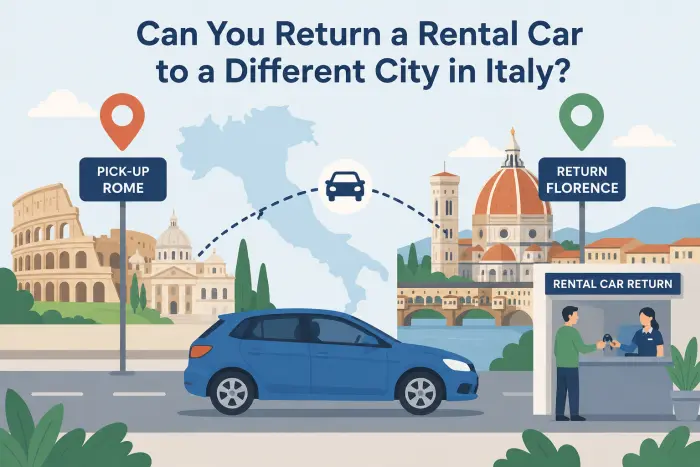
Within Italy itself, the process is simple enough that it barely needs explaining twice — pick your drop-off city during booking, pay the one-way fee shown at checkout, and go. Crossing into France, Switzerland, or anywhere outside Italy with the same car is where genuine planning matters, and where a surprising number of travelers assume the same simplicity applies when it genuinely doesn’t.
One-Way Rentals Within Italy
Domestic one-way rentals — Rome to Florence, Milan to Rome, Naples to the Amalfi Coast — are widely available through most major companies, typically for a fee in the €30-€90 range depending on the specific route and distance. This is a routine transaction rental companies handle constantly, not something you need special approval for beyond selecting it during booking. The fee generally scales with distance and how in-demand the specific route is, so a short hop between nearby cities tends to sit toward the lower end of that range, while a longer diagonal crossing of the country runs closer to the top.
If you’re planning one of the more common routes specifically, we’ve covered several in depth:
For routes not covered specifically, the general pattern holds: confirm the exact fee during booking (it varies by distance and company, not a flat national rate), and book with enough lead time during summer, since one-way vehicles in popular categories can sell out faster than standard round-trip bookings. It’s also worth double-checking that your specific drop-off location is one your rental company actually services as a return point, rather than assuming every city has every company’s presence — smaller towns in particular may only be covered by a subset of the major providers.
Crossing an Actual Border: A Different Situation Entirely
This is where the real distinction lies, and it’s worth being precise about it: driving a rental car from Italy into another country is not the same transaction as a domestic one-way return, even though both get lumped together as “one-way rentals” in casual conversation.
A few things are true across nearly every major rental company:
- You must disclose the border crossing in advance, typically well before pickup, not decide spontaneously once you’re already driving. Crossing undisclosed voids your insurance entirely and makes you personally liable for the full cost of any damage or accident — a risk that can run into tens of thousands of euros, not a minor technicality.
- The fee is substantially higher than a domestic one-way, and varies enormously by company and country — anywhere from roughly €50 to over €1,000 depending on the specific route, company, and how far the car ends up from its home country.
- Not every company allows every destination country. Enterprise, for instance, permits travel to a specific list of countries including Switzerland and France, but requires contacting the branch at least 72 hours before pickup to arrange the necessary paperwork (a certificate confirming the vehicle’s insurance is valid for that trip).
- Credit card insurance often excludes Italy specifically, even when the broader cross-border trip itself is permitted — several major providers explicitly list Italy among the countries their card-based collision coverage doesn’t extend to. Our guide on which credit cards cover rental insurance in Italy covers this gap in more depth, since it catches renters who assume their card’s usual coverage travels with them everywhere. This is a genuinely important detail to sort out separately from the cross-border fee itself: even if a company approves your route and charges you the fee, that doesn’t automatically mean your personal insurance backup is actually valid for the trip.
For the full country-by-country picture — including which destinations are usually fine, which require extra insurance, and which specific car brands get excluded from certain routes — see our complete guide to crossing borders with an Italian rental car.
The practical upshot of all this: cross-border driving from Italy is genuinely possible and reasonably common, but it’s a decision that needs to be made and confirmed before you start driving, not something to attempt on a whim once you’re already near a border and curious what’s on the other side.
💸 Italy Car Rental Sale – Up to 40% Off Today
Find the cheapest car rental deals in Rome and across Italy. Compare prices instantly and lock in your discount before it's gone.
A Realistic Example: Italy to Switzerland
Driving from Italy into Switzerland is legal and common enough — Switzerland is part of the Schengen area, so there’s no border control to worry about in the traditional sense — but it comes with its own specific requirement: a Swiss motorway vignette, a sticker purchased for around $45 (roughly 40 Swiss francs) that’s required for using Swiss highways. Driving without one carries a real fine, reportedly around 200 Swiss francs. This is on top of whatever cross-border fee your specific rental company charges for the trip itself.
Border crossings between Italy and Switzerland aren’t always staffed, and enforcement varies by which specific crossing point and time of day you’re using — but the vignette requirement applies regardless of whether anyone checks your paperwork at the border itself, since it’s enforced separately on the Swiss motorway system. This is a useful example of the broader pattern with cross-border trips generally: even when the border crossing itself feels informal or unmonitored, the destination country’s own rules still apply in full, and being unprepared for them is entirely on the driver, not something a rental company will retroactively excuse.
Fee Ranges by Type of Return
| Return Type | Typical Fee Range | Advance Notice Needed |
|---|---|---|
| Domestic one-way (Rome-Florence, Milan-Rome, etc.) | €30-€90 | Select during booking |
| Cross-border to a neighboring country | €50-€1,000+ | Often 72 hours or more, company-dependent |
| Undisclosed cross-border crossing | Not a fee — a serious risk | Voids insurance entirely |
What to Actually Do If You’re Planning Either
For a domestic one-way return, simply select your drop-off city during booking and confirm the fee before finalizing — it’s shown clearly in most booking flows and doesn’t require anything beyond that. For a cross-border trip, contact your specific rental company directly well before your travel dates, confirm which countries are permitted under your specific rental agreement, ask explicitly whether your card-based or rental insurance actually extends to the destination country, and get any required documentation (like Enterprise’s certificate) arranged with enough lead time that it doesn’t become a last-minute scramble. Treating the two scenarios as fundamentally different from the outset — rather than assuming a domestic-one-way mindset applies once a border is involved — is the single most reliable way to avoid an expensive surprise partway through your trip.
FAQ
Can I rent a car in Rome and return it in a different Italian city? Yes, this is a standard one-way rental, widely supported by major companies for a fee typically in the €30-€90 range depending on the route.
Can I drive a rental car from Italy into another country? Often yes, but it requires disclosing the trip to your rental company in advance — driving across undisclosed voids your insurance and makes you personally liable for damage costs.
How much does a cross-border rental fee cost from Italy? It varies enormously by company and destination, roughly €50 to over €1,000, depending on the specific route and how far the car ends up from its home country.
Does my credit card’s rental insurance cover cross-border trips from Italy? Not always — several major card issuers specifically exclude Italy from their rental coverage, a detail worth confirming before assuming your usual card benefit applies.
Do I need a Swiss vignette if I drive a rental car from Italy to Switzerland? Yes, if you plan to use Swiss motorways — it’s a sticker costing around $45, with a real fine for driving without one.
How far in advance do I need to arrange a cross-border rental? It varies by company, but 72 hours before pickup is a reasonable minimum for many providers, and earlier is safer given the paperwork some companies require.
Is a domestic one-way rental within Italy the same process as crossing a border? No — domestic one-way returns are simple, routine bookings. Cross-border trips require advance disclosure, additional fees, and specific insurance confirmation.
What happens if I cross a border without telling my rental company? Your insurance becomes void entirely, and you become personally liable for the full cost of any damage, accident, or recovery — a genuinely serious financial risk, not a minor rule.