
“Book X weeks ahead” is the kind of advice that sounds definitive and is actually wrong more often than it’s right, because the correct answer genuinely depends on when you’re traveling and what you need. Book too early for a low-season trip and you might miss a later price drop. Book too late for a summer automatic-transmission rental and you might not find one at all.
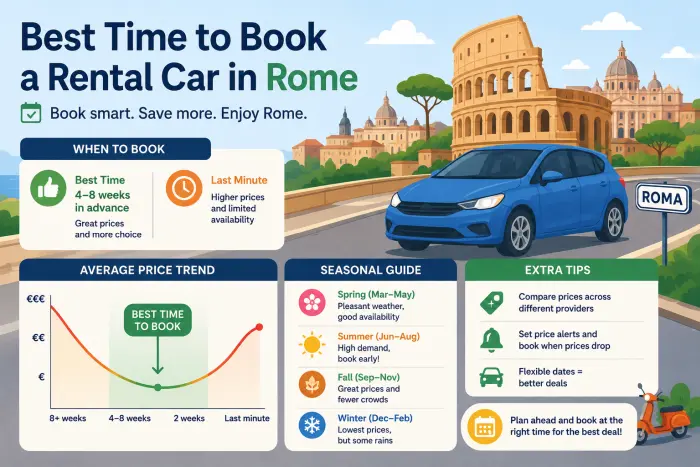
Here’s a realistic, season-by-season breakdown, plus the one strategy that works regardless of timing.
For summer travel (June-August), book 10-12 weeks ahead, especially for automatic transmission, which is in genuinely short supply in Italy. For shoulder season (April-May, September-October), 4-6 weeks is usually enough. For low season (November-March), 1-3 weeks ahead is typically fine, and prices in this window are more likely to drop than rise the longer you wait. Regardless of season, book with a free-cancellation option and re-book if the price drops before your trip.
Once you’ve nailed the timing, our guide on getting the lowest rental car rate in Italy covers the other levers — vehicle class, location, and payment choices — that affect the final price.
Booking Windows by Season
| Travel Season | Recommended Booking Window | Why |
|---|---|---|
| Summer (June-August) | 10-12 weeks ahead | Peak demand, automatic transmission scarcity, prices climb steadily as dates approach |
| Shoulder (April-May, September-October) | 4-6 weeks ahead | Moderate demand, still worth securing ahead of time |
| Low season (November-March) | 1-3 weeks ahead | Lower demand, prices often drop closer to the date rather than rise |
| Around Easter or April 25th (Liberation Day) | 8-10 weeks ahead | Domestic Italian travel spikes around these dates specifically |
This structure reflects a genuinely different dynamic than a lot of general travel-booking advice assumes: for much of the year, waiting doesn’t cost you anything and can actually save money, while during summer specifically, waiting is a real risk both to price and to simple availability.
Why Automatic Transmission Needs Extra Lead Time
This is a detail that catches a lot of visitors off guard: automatic transmission vehicles are a minority of the Italian rental fleet, since manual remains the default and most commonly available option nationwide. If an automatic is a requirement rather than a preference, this alone is reason enough to book meaningfully earlier than you otherwise might, particularly for summer travel through major hubs like Rome Fiumicino. Automatics also typically carry a price premium of roughly 10-15% over an equivalent manual, on top of being harder to find during peak months. Whichever transmission you end up with, it’s worth checking what deposit amount to expect for your vehicle class once your booking is confirmed, since this can shift with vehicle availability during busier periods.
The Book-Early-Then-Rebook Strategy
This is the single most consistently recommended tactic across experienced Italy renters, and it works regardless of season: book as soon as your travel dates are confirmed, using a free-cancellation rate, then periodically check the price again as your trip approaches. If a lower rate appears, cancel the original booking and rebook at the new price — most standard cancellation policies allow this without penalty up to 24-48 hours before pickup.
This approach effectively removes the guesswork from timing entirely: you’re never stuck with an early, higher price if the market moves in your favor, and you’re never left without a reservation if you’d waited and availability disappeared. The only requirement is confirming the specific booking is genuinely free-cancellation before relying on this strategy, since not every rate type allows it.
What Happens If You Book Too Early
For low-season travel specifically, booking many months in advance doesn’t reliably get you the best price — it’s just as likely, if not more likely, that the same vehicle will be available for less closer to your travel date. The exception is peak summer travel, where early booking is genuinely protective against both price increases and vehicles simply selling out, particularly for automatics and larger vehicle classes.
What Happens If You Wait Too Long
For summer and shoulder-season travel, waiting past the recommended windows above risks two compounding problems: rising prices as availability narrows, and outright unavailability for specific vehicle types (automatics, SUVs, larger family vehicles) at popular pickup points like Fiumicino. For low-season travel, the main risk of waiting is simply running out of time to compare enough options, rather than a meaningful price penalty — Italy’s off-season rental market has enough spare capacity that last-minute low-season bookings are rarely a problem.
💸 Italy Car Rental Sale – Up to 40% Off Today
Find the cheapest car rental deals in Rome and across Italy. Compare prices instantly and lock in your discount before it's gone.
A Few Rome-Specific Timing Notes
Rome Fiumicino, as one of Italy’s busiest rental hubs, tends to follow the general seasonal pattern closely but with slightly more competition (and therefore slightly more room for savings) than smaller regional airports, simply due to the sheer number of companies operating there — our comparison of Rome airport rental companies covers how that competition plays out in practice. If your trip includes a one-way rental or a specific hard-to-find vehicle class, adding a couple of extra weeks to whichever seasonal window applies is a reasonable buffer. Understanding the typical cost benchmarks by vehicle class also helps you judge whether a given quote, at whatever point you’re booking, is actually a good deal or not, and it’s worth pairing this with our broader guide on avoiding hidden costs so timing savings aren’t erased by fees elsewhere.
Does the Pickup Day of the Week Matter?
Less than the season, but enough to be worth knowing. Friday-through-Sunday pickups consistently see tighter availability than a Tuesday or Wednesday start in the same week, simply because they overlap with both short city-break tourists and Italians renting for their own weekend plans. If your dates have any flexibility at all, shifting a pickup by a day or two toward the middle of the week can mean a slightly better rate and a wider choice of vehicle class — though this gap narrows during true peak summer weeks, when almost everything is in high demand regardless of which day you start.
Ferragosto Deserves Its Own Warning
August 15th and the days around it are a category of their own, even within an already-busy Italian summer. Ferragosto is when much of the country travels domestically at the same time international visitors are near their own peak, and the combination empties out rental fleets faster than a normal August week. If your trip overlaps with Ferragosto, Easter, or the Christmas–New Year stretch, treat the booking window from the table above as a floor, not a target — book at the earlier end of the range, not the later one.
FAQ
How far in advance should I book a rental car in Rome for a summer trip? Generally 10-12 weeks ahead, especially if you need an automatic transmission, which is in limited supply and books up faster during peak season.
Is it cheaper to book a rental car in Rome last-minute? It depends on the season. For low-season travel (November-March), waiting can genuinely lead to a lower price. For summer travel, waiting typically means higher prices and reduced availability.
Do I need to book further ahead if I want an automatic transmission car? Yes, meaningfully so. Automatic transmission vehicles are a minority of Italy’s rental fleet, so booking earlier, especially for summer travel, significantly improves your chances of securing one.
What’s the “book and rebook” strategy for rental car pricing? Booking early with a free-cancellation rate, then monitoring the price and rebooking at a lower rate if one appears before the trip — most standard cancellation policies allow this without penalty.
Is there a specific time of year when Rome car rentals spike in price beyond normal summer demand? Yes, around Easter week and Italy’s April 25th Liberation Day holiday, when domestic travel increases demand beyond the general shoulder-season pattern.
How much more expensive is an automatic transmission car in Italy? Typically around 10-15% more per day than an equivalent manual transmission vehicle, on top of being harder to find during busy periods.
Should I book a rental car in Rome the same way for a short winter trip as a summer trip? No — winter (low season) bookings generally only need 1-3 weeks of lead time, much shorter than the 10-12 weeks recommended for summer travel.
Does booking earlier always guarantee a lower price in Rome? No, particularly outside of peak season. For much of the year, prices are just as likely to drop as rise the closer you get to your travel date, which is why the rebooking strategy is worth using regardless of when you first book.