
Picture the moment: your rental breaks down on the shoulder of the A1 outside Rome, and the correct legal move — before you even open the door — is to put on a reflective vest that’s supposed to be sitting in the passenger compartment, not zipped inside a suitcase in the trunk. Most visitors have no idea this rule exists until they’re standing at the roadside figuring it out in real time, which is exactly the wrong moment to be learning it.
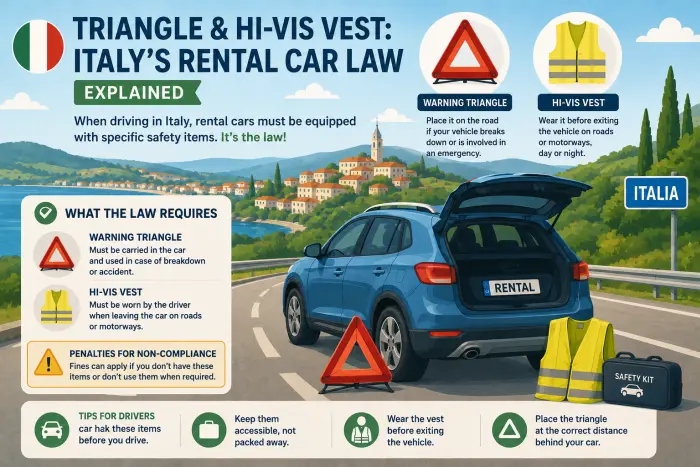
Italy treats this as actual law, not a suggestion: every vehicle on the road, rental cars included, is required to carry a warning triangle and a high-visibility vest, and there are specific, enforceable rules about where you keep them and how you use them. None of it is complicated once you know it, but almost nobody explains it to tourists before they pick up the keys.
What’s actually required by law
Two items, no exceptions for rentals: a warning triangle to signal a stopped vehicle, and a reflective high-visibility vest (or braces) that meets the EN 471/EN 20471 standard. Both are meant for the same basic situation — a breakdown or accident outside a built-up area — and Italian traffic law treats having them, and using them correctly, as your responsibility as the driver, not something the rental company handles for you once you’re on the road.
Why the vest has to live in the cabin, not the trunk
This is the detail that trips people up most: you’re required to put the vest on before you get out of the car, which is physically impossible if it’s packed away in the boot. Italian guidance is explicit that the vest or braces should be kept in the passenger compartment specifically so you can put them on while still inside the vehicle, before you ever step onto the road. If your rental car’s vest turns up buried under your luggage in the trunk, that’s already a problem waiting to happen — move it to the door pocket or glovebox as soon as you notice.
Where the triangle actually goes
Distance matters here, and it changes depending on the road. On a motorway or similar fast road, the triangle typically needs to be placed around 100 meters behind the stopped vehicle; on ordinary roads, roughly 50 meters is the expected distance. The idea is simple — give approaching traffic enough warning distance to react, especially around a bend or a rise where your car itself might not be visible in time. Position it on the same side of the road as the hazard, and only after you and any passengers are safely off the roadway itself.
When you’re actually required to use them
The obligation kicks in specifically for a breakdown or accident outside a built-up town or city center — inside dense urban areas the rules are a little looser, but on a rural road, provincial route, or the autostrada, both the triangle and the vest are expected the moment you’re stopped and need to be visible. This is also where it connects directly to what to do if you’re actually broken down: our guide on what happens when your rental car breaks down in Rome covers the roadside-assistance and towing side of things, while this equipment is what keeps you safe and legal in the minutes before help arrives.
If your situation is a collision rather than a mechanical breakdown, the same equipment rule applies at the roadside stage, but the paperwork afterward is different — our guide to rental car accidents in Italy covers the CAI form and when calling 112 is mandatory versus optional.
Items people assume are required but aren’t
Travelers arriving from other parts of Europe sometimes bring a first aid kit or a fire extinguisher expecting it’s mandatory in Italy too, since several neighboring countries do require one or both. Neither is a legal requirement here — genuinely useful to have on a long road trip, but not something that will get you fined for missing. The same goes for spare headlight bulbs: recommended, especially if your car still uses older non-LED lighting, but not a legal checkbox item the way the triangle and vest are. Knowing this distinction matters if you’re piecing together a driving kit before a multi-country trip — buying everything “just in case” isn’t wrong, but it’s not what Italian law specifically demands.
Winter gear is the one seasonal exception worth flagging separately. On certain mountain and Alpine routes, snow chains or winter tires become mandatory during the colder months, which is a different rule from the triangle-and-vest requirement and applies regionally rather than nationwide. If your route heads toward the Apennines or further north in winter, that’s worth checking independently of everything covered here.
💸 Italy Car Rental Sale – Up to 40% Off Today
Find the cheapest car rental deals in Rome and across Italy. Compare prices instantly and lock in your discount before it's gone.
Why this rule exists in the first place
The logic is straightforward once you think through the scenario it’s built for: a car stopped on the shoulder of a fast road, at night or in poor visibility, with a driver standing outside it. Without the vest, that driver is nearly invisible to oncoming traffic until it’s too late to react; without the triangle placed at a real distance back, approaching vehicles get no advance warning at all. It’s less a bureaucratic checkbox and more a rule built directly around a specific, genuinely dangerous moment that happens to rental car drivers more often than you’d think, simply because breakdowns and minor accidents don’t check your travel itinerary before happening.
Does your rental car already have this equipment?
In most cases, yes — Italian-registered rental vehicles are legally required to carry this equipment as standard, so a compliant fleet car should already have a triangle and vest somewhere inside. The problem isn’t usually absence, it’s location and condition: a vest crammed at the bottom of the trunk under the spare tire cover doesn’t help you if you can’t reach it before stepping out, and it’s worth a thirty-second check the moment you get the keys.
| What to check | Where to look |
|---|---|
| Warning triangle present | Trunk, often near the spare tire compartment |
| Vest or braces present | Glovebox, door pocket, or seat-back pocket — should be in the cabin |
| Vest condition | Should look intact and clearly reflective, not faded or torn |
| If missing entirely | Flag it at the counter before driving off, not after |
What happens if you don’t have it
Fines for missing mandatory equipment are a real enforcement risk, not a theoretical one, and figures commonly cited put the penalty for missing gear in the low-to-mid hundreds of euros, with late payment increasing the total. But the practical risk is arguably worse than the fine itself: being caught outside a stopped vehicle on a fast road with no visibility protection, in the dark or in poor weather, is a genuine safety hazard, which is the entire reason the law exists in the first place.
A note for anyone driving in from another country
If your road trip crosses a border — say, up toward Switzerland or France, which we cover in our guide to crossing borders with an Italian rental car — know that equipment requirements aren’t identical everywhere. Some countries want two triangles instead of one, others require a vest per occupant rather than just one for the driver. What satisfies Italian law doesn’t automatically satisfy the next country’s, so it’s worth a quick check if your itinerary extends beyond Italy’s borders.
Frequently asked questions
Do rental cars in Italy come with a warning triangle and vest included? Almost always, since Italian-registered vehicles are legally required to carry this equipment. Check at pickup that both are present and that the vest is somewhere reachable from inside the cabin, not buried in the trunk.
Where should the reflective vest be stored in the car? In the passenger compartment — a door pocket, glovebox, or seat-back pocket — so you can put it on before getting out of the vehicle, as the law requires.
How far from the car should the warning triangle be placed? Roughly 100 meters behind the vehicle on a motorway or fast road, and around 50 meters on an ordinary road, positioned on the same side as the hazard.
Is the vest mandatory inside city centers too, or just on rural roads and highways? The strict requirement applies specifically outside built-up areas — rural roads, provincial routes, and motorways — where visibility and vehicle speeds make it most critical.
What’s the fine for not having this equipment in Italy? Reported figures commonly fall in the low-to-mid hundreds of euros, with late payment increasing the amount, though the exact figure can vary by circumstance.
Do these requirements apply to every country I might drive through on a longer European road trip? No. Requirements differ by country — some ask for two triangles, others a vest per passenger rather than one per vehicle — so check the rules for each country on your route rather than assuming Italy’s requirements travel with you.