The temptation when booking is to pick based on price or whatever photo looks best in the listing. A more useful approach starts with your actual trip — who’s traveling, how much luggage, what kind of driving you’ll be doing — and works backward to the vehicle class that genuinely fits, rather than the other way around.
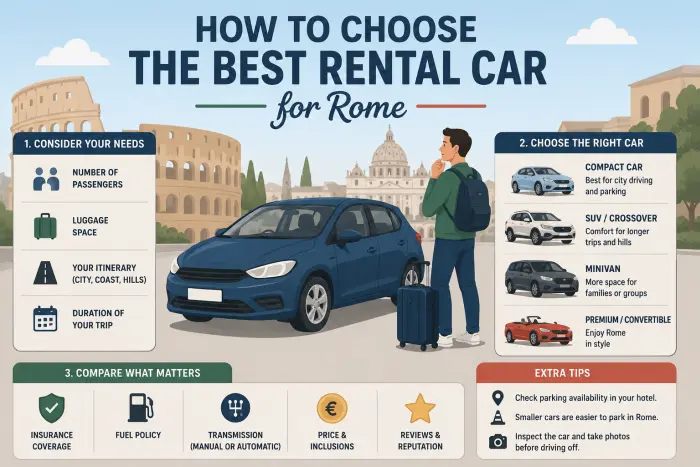
🚗 Decision Time: Match your vehicle to your trip pattern, not your budget alone: economy/compact for solo or couple city stays, standard/SUV for families or road trips with real luggage, 7-9 seat for larger groups, and automatic or EV specifically if you’re not comfortable with manual transmission (which remains the Italian default). Getting the size right the first time avoids a costly counter upgrade later.
If you’re weighing automatic against manual specifically, our automatic transmission guide for Rome covers availability and the real cost difference in more depth.
Start With Your Actual Trip, Not the Vehicle List
Before comparing specific models, it helps to answer a few questions honestly: how many people are actually traveling, how much luggage will you have, is your trip mostly within Rome or does it include regional road trips, and do you have a genuine preference on transmission or fuel type. These answers narrow the realistic vehicle class range considerably before you even start comparing prices — and they prevent the common mistake of booking based on the cheapest listed option, only to discover it doesn’t actually fit your group or luggage. A vehicle that’s too small for your actual needs often ends up costing more overall once you factor in an unplanned upgrade at the counter, which is rarely priced as favorably as booking the right size from the start.
Vehicle Class by Group Size and Luggage
| Group Size | Recommended Class | Notes |
|---|---|---|
| Solo or couple | Economy/Compact | Easiest to park and maneuver on narrow streets |
| Small family (3-4) | Standard/Intermediate | More luggage room, still manageable in the city |
| Larger family or group needing space | SUV | Higher driving position, better for road trips |
| 5+ passengers | 7-9 seat vehicle | Check whether it’s genuinely full-size seating or a compact configuration |
Larger vehicles genuinely help with luggage and comfort on longer trips, but they add real friction in Rome’s historic center specifically — narrower streets, harder parking, more caution needed at tight turns, and a higher chance of an accidental brush with a curb or wall on streets that weren’t designed with modern vehicle widths in mind. If your trip is mostly city-based with only occasional day trips, a smaller class often serves you better overall than a larger one that sits underused (and harder to park) most of the time. This is also worth weighing alongside Rome’s ZTL restricted zones, since a smaller car gives you marginally more flexibility navigating unfamiliar streets while you’re still getting oriented.
Manual vs Automatic vs Electric
Manual transmission remains the default across the Italian rental fleet, and choosing it is the simplest way to access the widest selection and lowest prices. If manual driving isn’t something you’re comfortable with, automatic is available but carries a price premium and requires booking further ahead, particularly for summer travel when automatics are in short supply. A less obvious alternative: electric and hybrid vehicles are automatic by default, which sidesteps the automatic-scarcity problem entirely while sometimes costing less than a traditional automatic combustion vehicle.
Fuel Type for Your Specific Itinerary
For city-focused stays, fuel type matters less — short distances mean the cost difference between petrol, diesel, and electric is relatively minor. For longer road trips, it matters more: diesel is often more cost-effective than petrol on extended highway driving, while electric requires genuine route planning around charging availability, particularly outside major cities. Our average cost breakdown by vehicle class is a useful baseline for weighing these trade-offs against your specific budget, since fuel type interacts with both the rental rate itself and your realistic running costs across the trip.
💸 Italy Car Rental Sale – Up to 40% Off Today
Find the cheapest car rental deals in Rome and across Italy. Compare prices instantly and lock in your discount before it's gone.
Extra Features Worth Actually Considering
- Air conditioning — essential for Italian summers, though standard on nearly all rental classes at this point
- Parking sensors or a rearview camera — genuinely useful for narrow city parking, worth requesting if choosing between similar vehicles within a class
- Child seats — request well in advance if needed, since availability is limited and quality varies by company
- Automatic emergency braking and lane-keeping assist — increasingly standard on newer vehicles, worth a quick check if these safety features matter to you specifically, since older fleet vehicles in some classes may not include them
- Insurance coverage level — this is a separate decision from vehicle class entirely, but worth finalizing alongside your vehicle choice rather than as an afterthought at the counter — our complete rental insurance guide covers what’s included by default versus what’s worth adding
A Simple Decision Checklist
- Count your actual group size and luggage honestly, not optimistically, before selecting a class
- Decide your transmission approach — manual for the widest selection and lowest price, automatic or EV if manual isn’t an option
- Consider whether your trip is city-focused or road-trip-heavy, since this affects both the ideal vehicle size and fuel type
- If you need a larger vehicle, verify the exact seating configuration rather than assuming “7-seater” means genuine full-size rear seats throughout — our 7-seater and minivan guide covers this distinction
- Finalize insurance and add-ons as a deliberate decision, not a counter-side afterthought
Getting these decisions right before you book, rather than reconsidering them at the counter under mild time pressure, is genuinely the single biggest factor in whether your rental car ends up matching your trip or fighting against it for the whole duration.
FAQ
What’s the best rental car size for a Rome city trip? Economy or compact is generally best for solo travelers or couples staying mostly within the city, given narrower streets and more limited parking.
Should I get an automatic or manual rental car in Rome? Manual offers the widest selection and lowest price, since it’s Italy’s default. Automatic is available but costs more and requires earlier booking, especially in summer.
Is an SUV a good choice for driving in central Rome? Not ideally — SUVs are better suited to road trips and longer drives than navigating central Rome’s narrow historic streets and tight parking.
How do I know if a “7-seater” rental actually has full-size seating? Check the specific model rather than relying on the seat count alone — some listings use a “5+2” configuration with smaller rear seats better suited to children than adults.
Does fuel type matter for a short city-based rental? Less so than for a longer trip — the cost difference between petrol, diesel, and electric is relatively minor for short distances within Rome itself.
Is diesel cheaper than petrol for a road trip in Italy? Generally yes, for extended highway driving specifically, diesel tends to be more cost-effective than petrol.
Should I book child seats in advance or request them at the counter? In advance — availability is limited, particularly during peak season, and requesting at the counter risks none being available.
Is it worth paying more for a vehicle with parking sensors or a rearview camera? It can genuinely help with tight city parking, and is worth considering when choosing between similar vehicles within the same class.