
Putting a rental car on an Italian ferry is generally legal — Sardinia, Sicily, and smaller islands like Elba and Ischia all accept vehicle ferries as a matter of course. ⛴️ The catch isn’t the law, it’s your specific rental agreement: plenty of companies restrict or flatly prohibit taking their car onto a ferry as a matter of their own policy, regardless of what’s legally allowed, and that restriction rarely shows up until you actually ask. For anyone renting in Rome, this question usually starts at Civitavecchia — Rome’s own port, and the mainland departure point for ferries to Sardinia.
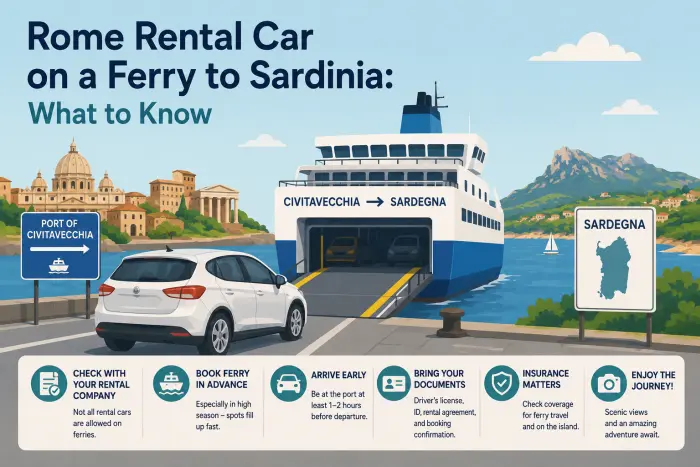
⛴️ Before You Book the Ferry: Legal permission and company permission are two different things — always confirm directly with your specific rental company before booking a ferry crossing, since a car taken onto a ferry without authorization can void your insurance entirely. Civitavecchia to Olbia, the main Sardinia route from Rome’s port, runs roughly six to seven hours. Sicily is a longer, less direct trip from Rome specifically, typically departing from Naples or Calabria rather than Civitavecchia. For many travelers, renting a separate car once you’ve arrived on the island works out cheaper and simpler than ferrying one over from the mainland.
Is It Actually Legal to Take a Rental Car on an Italian Ferry? ⚖️
Yes — Italian ferry operators generally accept rental vehicles the same way they accept privately owned cars, with no special legal restriction tied to the car being a rental rather than personally owned. This applies to major islands like Sardinia and Sicily as well as smaller destinations such as Elba, Giglio, Capri, Ponza, and the Aeolian Islands. The legal side of this isn’t the obstacle — it’s almost entirely about what your specific rental company allows.
Does Your Rental Company Actually Allow It? 📋
This is the question that actually matters, and it’s rarely answered by the standard rental agreement without asking directly. Many companies restrict ferry travel by their own policy, sometimes requiring advance written permission, sometimes charging an additional fee, and occasionally prohibiting it outright regardless of destination. This isn’t a universal rule — some companies handle it routinely — but assuming permission because the ferry operator itself allows rental cars is a mistake worth avoiding. Confirm directly with your specific company before booking a ferry crossing, ideally in writing, so you have something to point to if a question comes up later.
| Step | Why it matters |
|---|---|
| Ask your rental company directly, before booking the ferry | Policy varies significantly by company, not by law |
| Get permission in writing if possible | Protects you if a dispute comes up later |
| Confirm whether a fee applies | Some companies charge extra for cross-region or island travel |
| Check your insurance coverage specifically for ferry travel | Coverage may not automatically extend to vehicle-ferry transport |
Civitavecchia: Rome’s Own Gateway to Sardinia 🚢
Civitavecchia sits about an hour from central Rome and is the mainland departure point for ferries to Sardinia, most commonly to Olbia in the northeast of the island. It’s also the same port covered in our cruise rental guide, since it doubles as Rome’s cruise terminal — worth a look if your trip involves both a cruise and a potential island crossing, since the port logistics overlap considerably.
| Route from Civitavecchia | Approximate crossing time |
|---|---|
| Civitavecchia → Olbia (Sardinia) | Roughly 6–7 hours |
| Civitavecchia → Golfo Aranci (Sardinia) | Similar range, seasonal availability varies |
Exact schedules and operators change by season, so check current listings directly with ferry operators like Moby Lines, GNV, or Tirrenia closer to your travel dates rather than relying on a fixed schedule.
What About Sicily? 🌋
Sicily is a different story from Rome specifically — the more direct ferry routes to Sicily typically depart from Naples or from Villa San Giovanni in Calabria, not Civitavecchia, which makes a Rome-based rental-to-Sicily ferry trip a longer, multi-leg undertaking rather than a straightforward port hop. If Sicily is part of a broader road trip through southern Italy, our Rome to Bari route covers a similar southern-Italy driving stretch, and our Rome to Amalfi Coast route is worth reading too if your itinerary already runs south before any island crossing — the same general advice applies to both: confirm ferry permission with your rental company well before you’re standing at a port with a car they may not have approved for the crossing.
Is It Actually Cheaper to Rent a Separate Car on the Island? 💶
Often, yes — and it’s worth running the comparison honestly before assuming ferrying your Rome rental is the simpler choice. Ferry fees for a vehicle add a meaningful cost on top of the crossing itself, the crossing takes the better part of a day each way, and many travelers find that flying to Sardinia or Sicily and picking up a local rental works out both cheaper and considerably faster than the ferry option, especially if the island portion of the trip is short relative to the whole itinerary.
| Approach | Best for |
|---|---|
| Ferry your Rome rental to the island | Longer trips where you want one continuous rental and don’t mind the crossing time |
| Fly and rent separately on the island | Shorter island stays, tighter schedules, avoiding ferry fees and crossing time |
Insurance While the Car Is on the Ferry 🛡️
Standard rental insurance doesn’t automatically account for the car being loaded onto a vessel, and this is exactly the kind of detail worth confirming as part of getting ferry permission in the first place, not as an afterthought. Our insurance guide covers what standard coverage tiers generally include, and it’s worth asking your specific company directly whether ferry transport is treated any differently under your policy before you commit to the crossing.
💸 Italy Car Rental Sale – Up to 40% Off Today
Find the cheapest car rental deals in Rome and across Italy. Compare prices instantly and lock in your discount before it's gone.
Does It Matter Which Company You Rented From? 🏢
Yes, meaningfully. Larger international brands and established Italian operators tend to have clearer, more consistently applied policies on ferry travel, simply because it’s a common enough request that they’ve formalized an answer rather than deciding case by case. Smaller or independent operators may be more flexible on a personal level but also more inconsistent, which cuts both ways — sometimes a quick yes, sometimes a firm no with little room to negotiate. It’s a reasonable factor to weigh in our brand comparison guide if an island crossing is part of your plan from the start, rather than something you decide on mid-trip.
Does This Affect Your Deposit? 💳
If your rental company does approve a ferry crossing, it’s worth asking whether that approval comes with any change to your deposit or coverage terms — some companies treat an approved island crossing as a modification to the original agreement, which can mean a larger hold or a brief re-confirmation process. Our deposit guide covers how holds generally work, worth reviewing alongside any ferry-specific terms your company adds once they’ve confirmed permission.
Frequently Asked Questions
Can I legally take a rental car on a ferry to Sardinia or Sicily? Yes — Italian ferry operators generally accept rental vehicles the same as privately owned cars. The restriction, if any, comes from your specific rental company’s own policy, not from the law.
Do all rental companies allow their cars on ferries? No — policies vary considerably. Some allow it routinely, others require advance written permission or charge a fee, and some prohibit it outright. Always confirm directly with your specific company before booking.
How long is the ferry from Civitavecchia to Sardinia? Roughly six to seven hours to Olbia, the most common route from Rome’s port. Exact schedules vary by season and operator.
Is Civitavecchia the departure port for Sicily too? No — Sicily ferries more commonly depart from Naples or Villa San Giovanni in Calabria, making a direct Rome-to-Sicily ferry trip less straightforward than the Sardinia route from Civitavecchia.
Is it cheaper to ferry my rental car or rent a new one on the island? It depends on your trip length, but for shorter island stays, flying and renting locally often works out cheaper and faster than paying vehicle ferry fees and losing the better part of a day each way to the crossing.
Does my rental insurance cover the car while it’s on the ferry? Not automatically — it’s worth confirming directly with your rental company as part of getting ferry permission, since standard coverage doesn’t always account for vehicle-ferry transport by default.
What happens if I take a rental car on a ferry without permission? It can void your insurance coverage and create a serious dispute with the rental company, since an unauthorized ferry crossing falls outside the terms you originally agreed to. Getting permission in writing beforehand avoids this entirely.
A rental car on an Italian ferry is a genuinely workable option, but it’s a company-policy question first and a logistics question second — confirm permission before you book the crossing, not after. For many trips, especially shorter island stays, flying over and renting locally ends up simpler than the ferry route anyway, and it’s worth honestly comparing both before committing to either.