
Most advice about driving in Rome boils down to one sentence: don’t, at least not in the historic centre. That’s genuinely correct, and our ZTL guide and parking guide already cover why in detail. But that advice quietly skips a real question: if a car is the wrong tool for the centre, what is it actually the right tool for? Rome is a sprawling city, and several genuinely worthwhile parts of it sit exactly where a car helps and public transport struggles. Here’s where that’s true — and, just as usefully, where it still isn’t.
Via Appia Antica: The Clearest Case for Driving
The Appian Way is the single best argument in this entire city for having a car, and it’s not close. This is a 16-kilometre stretch of ancient Roman road running through countryside, past 2,000-year-old tombs, catacombs, and the ruins of imperial villas — spread out over a distance that makes walking the whole thing impractical and public transport a genuinely awkward, infrequent option. A car lets you drive the length of it, stopping at the catacombs of San Callisto, the Villa dei Quintili, and the Circus of Maxentius in whatever order and pace suits you, rather than committing to a single bus route’s schedule. Weekends see sections of the road closed to general traffic for cyclists and pedestrians — worth checking current restrictions before you go, since the rule changes by day and season.
EUR: Rome’s Modernist District, Built at Car Scale
EUR (Esposizione Universale Roma) is a genuinely different Rome — wide boulevards, Fascist-era rationalist architecture, and a layout designed in the 1930s and 40s around cars and grand vistas rather than the medieval pedestrian scale of the historic centre. It’s home to the Palazzo della Civiltà Italiana (the “Square Colosseum”) and a scattering of museums, and it’s spread out enough that a car genuinely changes how much of it you can cover in a morning versus trying to walk between its widely spaced landmarks. It’s also outside any ZTL restriction, meaning none of the central Rome parking headaches apply here.
Ostia Antica and Ostia Beach: Two Stops, One Trip, One Car
Ostia Antica — Rome’s ancient port city, remarkably well preserved and considerably less crowded than the Colosseum despite being comparably significant — sits about 25km from central Rome. It’s reachable by train, but doing it by car opens up a natural pairing that the train route doesn’t: Ostia’s modern beach, a short drive further, giving you ruins in the morning and the coast in the afternoon without backtracking through the city centre in between. This kind of two-stop combination, geographically adjacent but not connected by a single convenient transit line, is exactly the situation where a rental car earns its cost for the day.
Cinecittà: For a Specific, Niche Interest
If Italian cinema history is genuinely your interest — Cinecittà Studios, where Fellini, Rossellini, and decades of Italian film history were made — this sits in a part of Rome that’s straightforward enough by metro, so a car isn’t strictly necessary here on its own. It becomes worth combining with a car trip mainly if you’re already pairing it with EUR or Appia Antica on the same day, given their relative proximity to each other on the city’s southeastern side.
Where a Car Still Doesn’t Help: The Historic Centre
To be direct about the flip side: the Colosseum, the Forum, the Pantheon, Trastevere, and the entire historic core remain a walking-and-metro proposition, not a driving one. ZTL restrictions cover much of this area during the day, parking is scarce and expensive where it exists at all, and the distances between major sights are short enough that a car adds friction rather than removing it. Our Colosseum and Vatican parking guide covers the honest reality if you do need to drive near these areas for a specific reason — arriving with luggage, for instance — but treat it as the exception, not the plan.
💸 Italy Car Rental Sale – Up to 40% Off Today
Find the cheapest car rental deals in Rome and across Italy. Compare prices instantly and lock in your discount before it's gone.
A Practical Way to Structure a Car Day
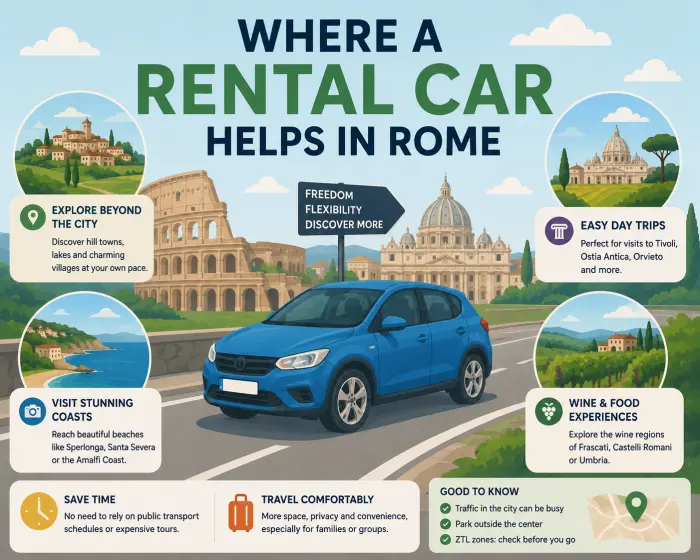
If you’re building a day around the car specifically, the natural grouping is Via Appia Antica in the morning, when the light and temperature are both easier for walking sections of the road, followed by EUR or Ostia Antica in the afternoon, depending on which second interest pulls you more. Park once at each stop rather than trying to weave in and out of the centre between them — the whole point of choosing these locations is that they reward a car precisely because they don’t ask you to fight historic-centre traffic and parking in between.
Frequently Asked Questions
Is it worth renting a car just to see Rome’s historic centre? No — the centre is genuinely better explored on foot and by metro, given ZTL restrictions, scarce parking, and short distances between major sights.
What part of Rome actually benefits most from having a car? Via Appia Antica, by a clear margin — its length and the spacing between its ancient sites make it awkward on foot or by infrequent bus routes, and a car lets you set your own pace along the whole stretch.
Can I drive the full length of the Appian Way? Generally yes, though sections close to general traffic on weekends for pedestrians and cyclists — check current restrictions for your specific date before planning your route.
Is EUR worth visiting if I don’t have a car? Yes, it’s reachable by metro, but its wide, spread-out 1930s-40s layout means a car noticeably increases how much ground you cover in the same amount of time.
Can I combine Ostia Antica and Ostia Beach in one day with a rental car? Yes — this is one of the more natural car-based day combinations near Rome, pairing the ruins with the coast a short drive further without needing to return through the city centre.
The real question isn’t whether to drive in Rome — it’s where. Keep the car for Via Appia Antica, EUR, and the Ostia combination, and leave it parked (or better, unrented for that portion of your trip) when your day is built around the historic centre. For everything the car does need to navigate around, our full driving in Rome guide covers ZTL zones, parking, and the rest of the rules that actually matter.